

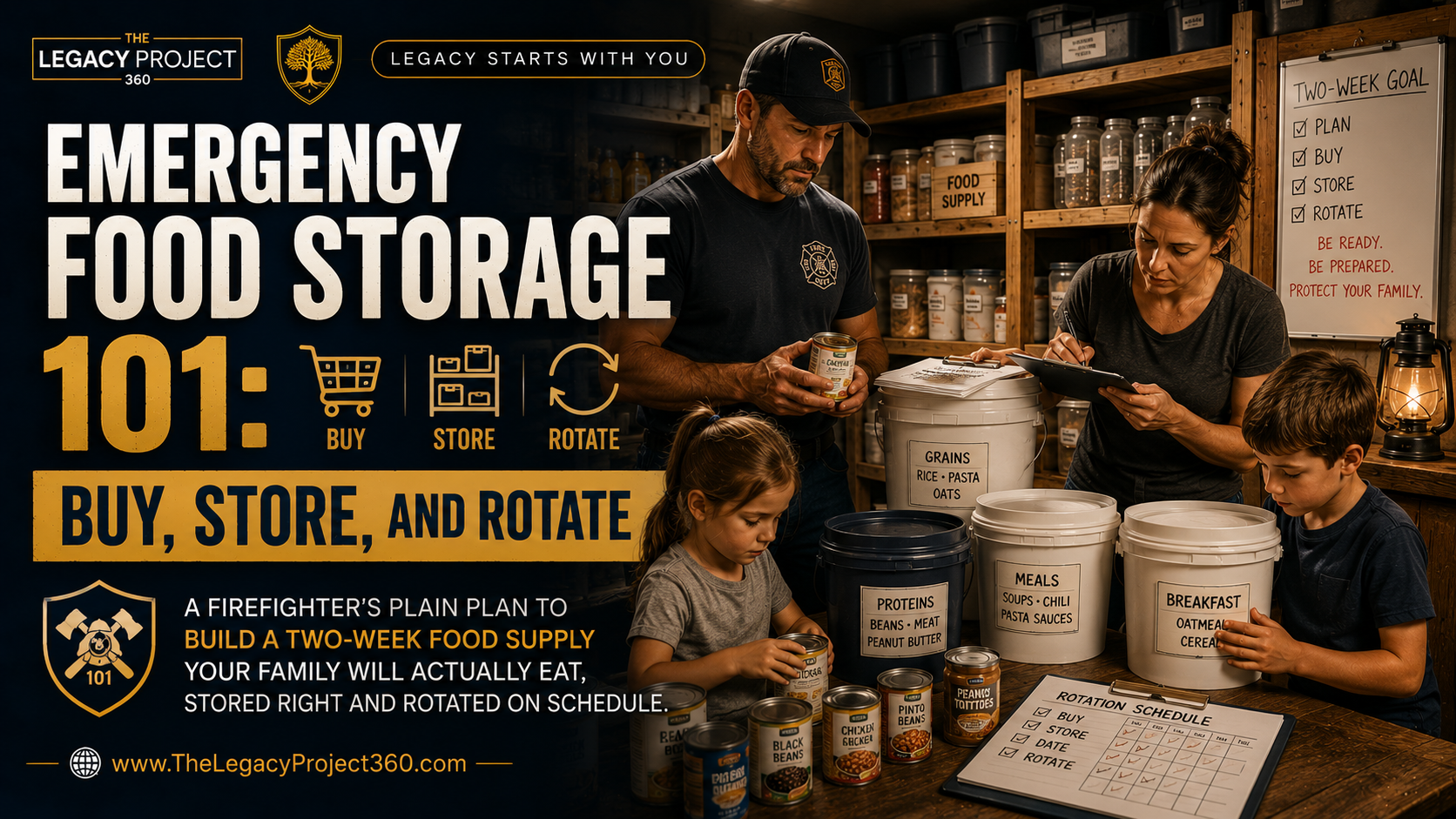
Only 5 percent of American homes report having a fully stocked emergency supply kit, according to a 2025 SafeHome.org national emergency preparedness study. Read it again. One in twenty. The other nineteen homes on your block are betting nothing bad will happen this year, next year, or the year after. As a firefighter, I have stood in those kitchens after the storm passes. The pantry is empty by day three. The kids are hungry. The parents are scrambling.
Emergency food storage is not survivalist theater. It is the simplest insurance policy your family will ever own. This post walks you through what to buy, where to store it, and how to rotate it so nothing spoils. By the end you will have a clear plan to build a two-week supply without panic, without overspending, and without filling your garage with buckets you forget about.
What You'll Learn
How Much Food Your Family Needs to Store
What to Buy for Emergency Food Storage
Where to Store Your Emergency Food (and Where Not to)
How to Rotate Your Food Storage So Nothing Spoils
How to Build a Two-Week Supply in 30 Days
Frequently Asked Questions
How Much Food Your Family Needs to Store
FEMA used to tell American families to keep 72 hours of food on hand. The agency has since updated the guidance. The current recommendation on Ready.gov is a two-week supply of non-perishable food and water for every person in your household.
Two weeks. Not three days.
The change reflects what emergency managers have learned from a decade of hurricanes, wildfires, and grid failures. After Hurricane Helene tore through western North Carolina in September 2024, some mountain communities went without resupply for more than a week. Power, water, and roads were gone. The 72-hour kit ran out on day four.
Here is the math for a family of four:
- Calories: roughly 2,000 per person per day. Two weeks equals 112,000 calories total.
- Water: 1 gallon per person per day per FEMA. Two weeks equals 56 gallons total.
- Meals: 42 breakfasts, 42 lunches, 42 dinners, plus snacks.
Those numbers feel large at first. Broken into a 30-day shopping plan, they become a manageable line item on your grocery budget. We will get to the plan in a few minutes.
If a two-week supply feels out of reach right now, start with a one-week target and build from there. The worst possible plan is no plan at all.
What to Buy for Emergency Food Storage
The best emergency food is the food your family already eats. Forget the freeze-dried buckets unless you have specific reasons to use them. A pantry full of food no one likes is a pantry no one will rotate, which means a pantry full of expired waste in three years.
Build your storage around four categories.
Shelf-Stable Proteins
These are the workhorses of emergency food storage. They keep for years and they make any meal feel like a real meal.
- Canned chicken, tuna, salmon, and ham
- Canned chili and beef stew
- Peanut butter (a 16-ounce jar holds about 2,500 calories)
- Dry beans and lentils
- Beef jerky and other dried meats
- Powdered milk
USDA Food Safety and Inspection Service guidance says low-acid canned foods like meat, poultry, fish, and most vegetables keep 2 to 5 years when stored properly. Some sources go further. Brigham Young University researchers tested 28-year-old wheat, pasta, and powdered milk in 2007 and found most still safe and palatable when sealed and stored at cool temperatures (BYU News, "Food Storage Has Long Shelf Life," 2007).
Shelf-Stable Carbohydrates
These give your meals weight and your family the calories they need.
- White rice (lasts up to 30 years sealed in a cool, dry place)
- Pasta and egg noodles
- Oatmeal and other rolled grains
- Crackers and pilot bread
- Tortillas in vacuum packs
- Instant potatoes
Brown rice is the exception. Its natural oils go rancid in about 6 months at room temperature. Stick with white rice for long-term storage and rotate brown rice through your normal pantry.
Fruits, Vegetables, and Acidic Foods
USDA guidance notes high-acid canned foods like tomatoes, grapefruit, and pineapple keep 12 to 18 months. Plan to rotate these more often than your low-acid cans.
- Canned vegetables (corn, green beans, carrots, peas)
- Canned tomatoes and pasta sauce
- Canned fruit in juice or water
- Applesauce cups
- Dried fruit (raisins, apricots, banana chips)
- Freeze-dried vegetables for soup bases
Comfort and Morale Foods
People underestimate this category and regret it later. After three days of canned beans, your kids will want something familiar. Morale food is preparedness food.
- Hard candy and chocolate (stored cool)
- Coffee, tea, and instant cocoa
- Honey (effectively immortal when sealed)
- Shelf-stable cookies and snack bars
- Spice packets, hot sauce, salt, and pepper
A bag of chocolate chips and a jar of instant coffee will do more for morale on day five than another pouch of freeze-dried beef stroganoff.
What to Skip
- Anything in glass for primary storage (heavy, breakable, hard to transport)
- Foods with high salt content if anyone in the home has hypertension
- Bulging, rusted, leaking, or deeply dented cans according to USDA guidance
- Anything you have never tasted (an emergency is a poor time for food experiments)
Where to Store Your Emergency Food (and Where Not to)
The USDA gives clear guidance on storage conditions. Keep canned and shelf-stable food in a cool, dry, dark place at temperatures below 85 degrees Fahrenheit. Heat is the enemy. Every 18 degrees above 70 degrees roughly cuts canned food shelf life in half (USDA Food Safety and Inspection Service, Shelf-Stable Food Safety).
The best places in most homes:
- An interior closet on the main floor or basement
- Under a bed in shallow plastic bins
- A finished basement away from the water heater and furnace
- A pantry on an interior wall
The worst places, even though plenty of people use them:
- The garage (temperature swings from below freezing to over 120 degrees Fahrenheit)
- The attic (the same problem, worse in summer)
- Above or beside the stove
- Under the kitchen sink (humidity, leaks, cleaning chemicals)
- An uninsulated basement near the furnace or water heater
If you live in an apartment with limited storage, get creative. The space under a queen bed holds about 24 cubic feet, enough for several weeks of food in low-profile bins. The top shelf of a coat closet holds another week. A storage ottoman at the foot of your bed adds another.
Emergency food storage is the simplest form of family insurance. The cost is a few hundred dollars. The payout is the peace of mind to look your kids in the eye when the lights go out and tell them everything is going to be fine.
How to Rotate Your Food Storage So Nothing Spoils
Storage without rotation is a slow-motion donation to the landfill. The principle every emergency manager teaches is FIFO. First In, First Out. The oldest food gets eaten first and replaced with new stock at the back of the shelf.
Here is the system I use in my own home and recommend to families I work with.
Label Every Item with the Purchase Date
Use a permanent marker. Write the month and year you bought it on the top of the can or the front of the bag. Forget the printed best-by date for storage purposes. The purchase date is what tells you whether to use the item this month or next year.
Build Your Pantry Like a Grocery Store Shelf
New stock goes in the back. Old stock comes to the front. When you cook this week, pull from the front. When you shop this week, restock the back. Over time the system runs itself.
Set a Quarterly Inspection
Mark four dates on your calendar. The first weekend of January, April, July, and October works for most families. Spend 30 minutes checking expiration dates, looking for damaged cans, and noting what to replace. Make a shopping list before you close the pantry door.
Use What You Store, Store What You Use
The biggest mistake families make with emergency food is buying things they would never eat in a normal week. If your family does not eat lentils on Tuesday, do not store fifty pounds of lentils for Tuesday during a hurricane. Build your storage around the meals you already cook. Spaghetti, chili, soup, beans and rice, breakfast oatmeal. Store extra of what you already love.
Donate Before It Expires
If something is approaching the one-year mark and your family will not eat it, donate it to a food bank while the food is still good. Replace it with something better suited to your taste. The point of emergency food storage is not perfection. The point is never throwing food away.
How to Build a Two-Week Supply in 30 Days
Most families look at a two-week food storage goal and freeze. The trick is to break it into four weekly add-ons of about $40 to $60 per shopping trip.
Week 1: Water and Quick Wins
56 gallons of water for a family of four (commercially bottled gallons or food-grade containers per FEMA guidance)
1 case of bottled water for go bags and immediate access
1 manual can opener (you will need this on day one)
Week 2: Proteins and Mains
12 cans of soup, chili, or stew
6 cans of chicken, tuna, or salmon
1 large jar of peanut butter
2 pounds of dry beans or lentils
Week 3: Carbs and Sides
5 pounds of white rice
5 pounds of pasta
4 jars of pasta sauce
1 large container of oatmeal
1 box of crackers
Week 4: Breakfast, Snacks, and Morale
1 box of breakfast bars
6 cans of fruit
1 large bag of trail mix or dried fruit
1 jar of honey
1 box of hot cocoa, instant coffee, or tea
1 bag of hard candy or chocolate
In 30 days you have moved from the average American household with a few snacks in the pantry to one of the 5 percent with a real two-week supply. The cost lands somewhere between $150 and $250 depending on store and brand. You spend more on takeout in a month.
For the documents and account information your family will need alongside the food in any real emergency, see The Family Documents You Need Organized Before a Crisis Hits and the Legacy Binder Family Preparedness System at thelegacybinder.com.
Frequently Asked Questions
How long does emergency food storage last?
USDA guidance says low-acid canned foods like meat, poultry, fish, and most vegetables keep 2 to 5 years stored below 85 degrees Fahrenheit. High-acid canned foods like tomatoes, grapefruit, and pineapple keep 12 to 18 months. Dry staples like white rice, beans, and rolled oats kept sealed in cool, dry conditions will last 10 to 30 years depending on the food and packaging.
Is freeze-dried food worth the cost for emergency storage?
Freeze-dried food has a 25 to 30 year shelf life and minimal weight, which makes it useful for go bags and long-term reserves. The cost runs three to five times higher per calorie than grocery store food. Most families are better served by building a rotating pantry of normal foods first and adding freeze-dried as a supplement once the basics are in place.
How much water should I store for emergencies?
FEMA recommends 1 gallon of water per person per day for drinking and basic sanitation. A two-week supply for a family of four is 56 gallons. Store water in commercially bottled containers or food-grade water storage containers in a cool, dark place. Do not reuse old milk jugs or fruit juice containers.
Do I need a generator for emergency food storage?
No. Properly built emergency food storage requires no refrigeration, no freezer, and no cooking. Everything in your two-week supply should be safe and edible cold from the can if needed. A generator is useful for other reasons, but it should not be the foundation of your food plan.
What is the most common mistake families make with food storage?
Buying food no one in the household will eat. A pantry full of unfamiliar freeze-dried meals is a pantry no one will rotate, which means it expires before it serves anyone. Build your storage around meals your family already loves. Use what you store and store what you use.
Conclusion
Emergency food storage is not about fear. It is about love. A two-week supply of food and water means your kids eat hot meals while the neighborhood waits for help. It means you sleep through the storm instead of lying awake counting cans. The plan is simple. Pick a place. Buy a little extra each week. Mark the dates. Rotate the stock. In a month you will be in the top 5 percent of prepared households in America. The next post in this preparedness library covers the other half of the equation, water storage, in the same level of detail.
When the food and water are in place, the documents come next. The Legacy Binder Family Preparedness System gives you one organized place for the medical, financial, and legal information your family will need when minutes matter. See the full system at thelegacybinder.com and start building the plan your family will thank you for.
Written by Paul T. Brewer, The Legacy Project 360.