

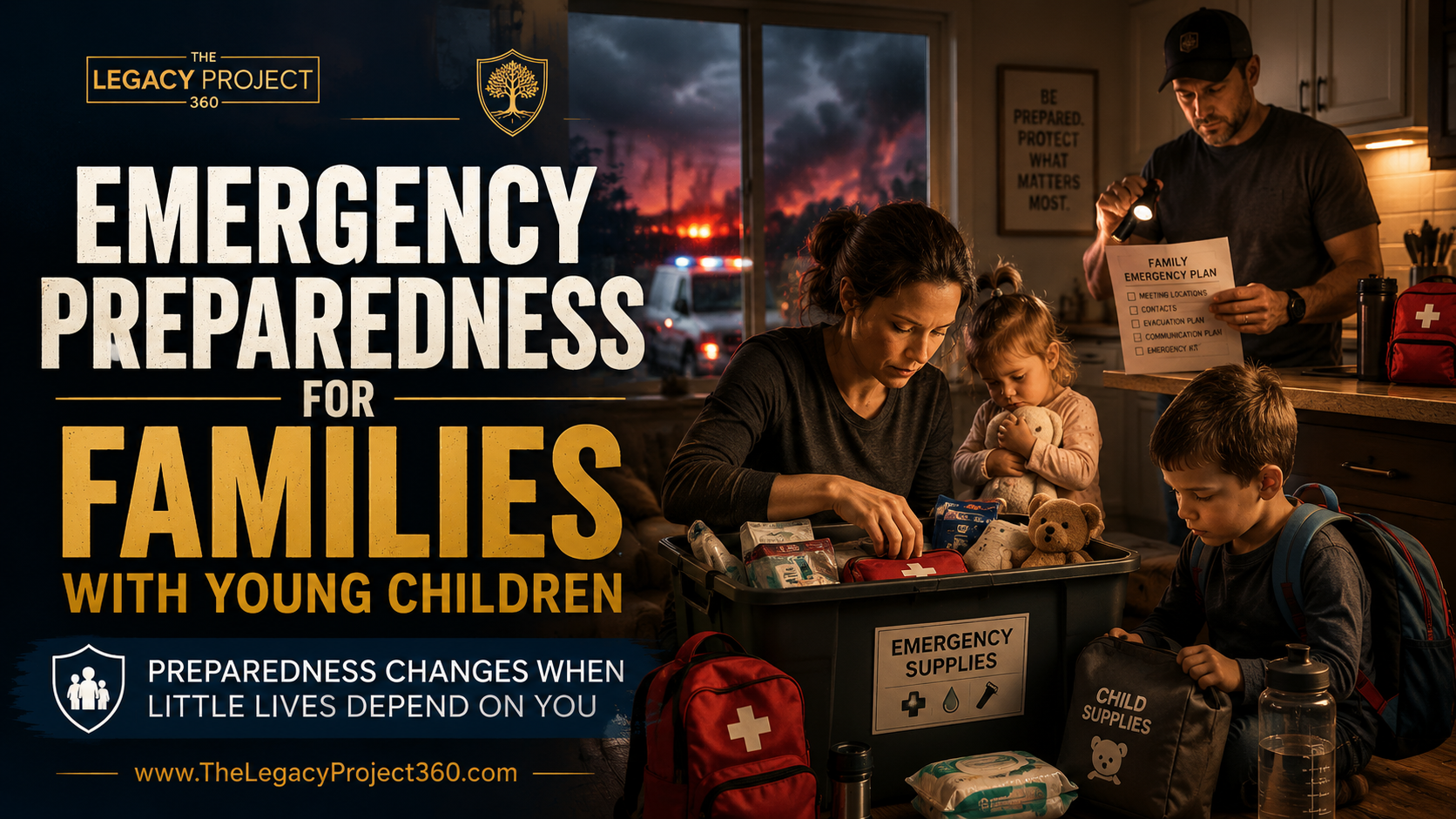
The power went out three hours ago. Your toddler keeps asking when the cartoons are coming back. The baby is on her last clean diaper. Your spouse is searching the kitchen by phone flashlight for something the kids will eat cold.
This is the moment most parents wish they had prepped for sooner.
Emergency preparedness for families with young children looks different from prepping for a couple or a single adult. Diapers run out. Formula spoils. Toddlers melt down without routines. And kids feel every ounce of stress you carry.
This post walks you through what to pack, what to store, and how to talk to your kids so the next emergency feels manageable instead of terrifying.
What You'll Learn
Why Preparedness for Families with Young Children Looks Different
What to Pack in a Kid-Ready Go Bag
How to Build a Home Emergency Kit Around Your Children's Needs
How to Talk to Young Kids About Emergencies Without Scaring Them
How to Practice Your Family Emergency Plan With Little Ones
Frequently Asked Questions
Why Preparedness for Families with Young Children Looks Different
Disasters do not pause for nap time. Children make up about a quarter of the U.S. population, according to FEMA, and they are among the groups most affected when emergencies strike because they depend on adults for food, shelter, communication, and medical care.
Young kids carry needs adults often forget about under stress. They need calories at predictable times. They need clean diapers. They need familiar comfort items. They need a parent who is not panicking.
Your prep plan has to account for all of it.
Here is what makes prepping with young children different:
Their needs change every few months. A four-month-old has different supplies than a fourteen-month-old.
They depend on you for everything. Food, water, hygiene, comfort, decision-making.
They pick up on stress fast. A scared parent makes for a scared kid.
They have small bladders, small stomachs, and big emotions.
Most adult preparedness lists ignore them entirely.
According to the American Academy of Pediatrics, families who talk with their child's pediatrician about disaster planning are far more likely to take action and prepare. So if you have a well-child visit coming up, ask your pediatrician what gaps to fill.
What to Pack in a Kid-Ready Go Bag
A go bag for your family looks like an adult go bag with a kid layer added on top. Pack one bag per child if you have multiples. The contents have to be easy to grab, easy to carry, and rotated with the seasons.
For each young child, your go bag should include:
Three days of diapers and at least two packs of baby wipes
Diaper rash cream and baby powder
Ready-to-feed formula in single-serve containers if you bottle feed
A few bottles of water for cleaning hands and gear
One change of clothes per day for three days
Two extra blankets
Nonperishable kid-friendly snacks rotated every six months
Small comfort item: a stuffed animal, blanket, or pacifier
Updated photo of each child in case you get separated
Copy of medical insurance card and immunization record
The CDC recommends ready-to-feed infant formula in emergencies because it comes sterile, in single-use containers, and does not require water. If your go bag has powdered formula, you also need clean water and a way to sanitize bottles.
Do not pack what your kids do not use. A formula they refuse to drink is not preparedness. It is wasted weight.
Match Your Bag to Your Child's Age
Newborn to 6 months:
Formula or breastfeeding supplies
Burp cloths and bibs
Pacifiers, doubled up because they will get lost
Small infant carrier
6 to 18 months:
Soft snacks
Sippy cup
Spoon
Teething items
Toddler to age 5:
Snacks they will eat without complaint
Small water bottle
A coloring book and crayons
A favorite small toy
Don't forget yourself either. A go bag for parents stays separate but lives next to the kids' bags by the door.
For the rest of your family, see our full guide on building a go bag at thelegacyproject360.com.
How to Build a Home Emergency Kit Around Your Children's Needs
Most home emergency kits are built for adults. They have flashlights, water, food bars, a radio, and not much else. If you have young children, you need to think bigger.
Start with FEMA's basic recommendation of one gallon of water per person per day for at least three days. A family of four needs 12 gallons minimum for a three-day window. Most experts now recommend stretching to two weeks where storage allows.
Then add the kid layer:
Two weeks of diapers, sized for your child's current weight
A backup case of formula or pouches if you use them
Extra pacifiers
Two flashlights for kids: small ones they hold themselves
Glow sticks (kids love them and they keep little ones calm at night)
A box of comfort foods: applesauce pouches, crackers, peanut butter, shelf-stable milk
Children's pain reliever and allergy meds
A digital thermometer
A first aid kit stocked for small bodies
Copies of birth certificates and immunization records in a waterproof bag
A current photo of each child
CALLOUT
YOUR KIDS DO NOT NEED TO KNOW THE WORST-CASE SCENARIO. THEY NEED TO KNOW YOU HAVE A PLAN, YOU PRACTICED IT, AND THEY HAVE A JOB TO DO. THAT IS THE DIFFERENCE BETWEEN FEAR AND CONFIDENCE IN A CRISIS.
Rotate Supplies with Your Child's Growth
Diapers move sizes fast. Formula expires. Snacks lose freshness. Set a calendar reminder every three months to open the kit and check sizes, expiration dates, and seasons. A box of newborn diapers does not help your 18-month-old.
This is also where the Legacy Binder Family Preparedness System pays off. Storing your supply lists, immunization dates, and rotation schedules in one place keeps the whole plan from falling apart when life gets busy. Learn more at thelegacybinder.com.
How to Talk to Young Kids About Emergencies Without Scaring Them
Kids feel everything you feel. The way you talk about emergencies shapes how they handle them. Stay calm. Use words they understand. Tie everything to their world.
For preschoolers, frame it like a game:
"We are going to practice what to do if the lights go out."
"Where do you think we keep our flashlights?"
"If we need to leave the house fast, what do we grab first?"
For grade-school kids, give them small jobs:
One child grabs the snack bag.
Another grabs the family pet.
Another helps the youngest sibling.
According to FEMA's Ready Kids program, children who participate in family preparedness feel more confident and less anxious during real emergencies. Giving them a role gives them control.
Avoid These Common Mistakes
Do not show kids disaster footage from the news. They do not have the context to process it.
Do not let them overhear adult fear-talk about worst-case scenarios.
Do not promise nothing bad will happen. Promise instead you have a plan.
Do not skip the drill. Kids retain by doing.
How to Practice Your Family Emergency Plan With Little Ones
Practice turns panic into pattern. Even toddlers respond well to a few short, repeated drills. Keep them simple. Keep them positive. Make them feel like part of the team.
Try these four practice runs over the next month:
The Lights Out Drill. Turn off the lights and walk through your blackout routine together. Where are the flashlights? Where do we meet?
The Quick Exit Drill. Practice grabbing the go bags and meeting at your designated outside spot.
The Helper Drill. Teach kids to look for a uniformed helper such as a firefighter, police officer, or store employee if they get separated.
The Phone Number Drill. Make sure each kid old enough to talk knows one parent's phone number and one out-of-area family contact. The American Red Cross recommends an out-of-area contact because text and long-distance calls often work when local lines are jammed.
Make it fun. Reward effort. Repeat it every few months. Your kids will start to see preparedness as something normal instead of something scary.
Frequently Asked Questions
At what age should I start teaching my kids about emergency preparedness?
Start as early as age 3. Toddlers learn through repetition and play. By preschool, your kids should know what a fire alarm sounds like, where to meet outside, and how to ask for help.
How much water should I store for a family with young children?
FEMA recommends one gallon per person per day for at least three days. For a family of four, store at least 12 gallons. Add extra for hygiene if you have a baby in diapers, since cleaning hands and bottles uses more water than you think.
What is the safest type of infant formula to keep in an emergency kit?
The CDC recommends ready-to-feed (RTF) formula in single-serve containers. It is sterile, requires no water, and reduces contamination risk during a crisis. Powdered formula works only if you have safe water and a way to sanitize bottles.
What should I do if my child is on prescription medication?
Keep at least a one-week supply of all critical medications in your emergency kit. Talk to your child's pediatrician about a backup prescription written for emergencies. Store medications in their original labeled containers.
How do I keep our preparedness plan current as my kids grow?
Rotate supplies every three months. Update diaper sizes, clothing sizes, snack preferences, and emergency contacts. Use the Legacy Binder Family Preparedness System to keep all your records, dates, and rotation schedules in one place at thelegacybinder.com.
Conclusion
Emergencies do not give parents a heads-up. They show up in the middle of dinner, at 3 a.m., or during the school drop-off. The families who walk through them with the least chaos are the ones who built a plan before they needed one.
Your kids do not need to know the worst-case scenarios. They need to know you have a plan, you practiced it, and they have a job to do. This is the difference between fear and confidence in a crisis.
Emergency preparedness for families with young children comes down to small, repeatable steps. The peace of mind is worth the weekend it takes to build.
Download the Legacy Binder Family Preparedness System at thelegacybinder.com and start putting your family's plan in writing this weekend. It walks you through every kid-specific document, contact, and supply checklist in one organized place. Your future self will thank you.
Written by Paul T. Brewer, The Legacy Project 360.