
Most families don't fall apart in a single moment. They fall apart in the silence of conversations that never happened.
I've seen it from the inside of an ambulance. I''ve seen it across kitchen tables. The pattern is almost always the same: love was there, but a plan wasn''t. So when the worst day came, the people left behind had to guess at everything — what mom would have wanted, where dad kept the insurance papers, whether to keep the house, who gets what, and why.
This article is the conversation guide I wish every family had. Five talks. One framework. Start tonight.
You don''t need a perfect plan to start. You need an honest conversation. Everything else is built from there.
Why "We''ll Get To It" Is the Most Dangerous Sentence in Your House
A 2024 study found that over 67% of Americans have no estate plan, and even fewer have shared their wishes with the people who would carry them out. The reason is almost never apathy. It''s discomfort. We avoid these talks because they feel morbid, because we''re busy, because we assume we have time.
Then the call comes — the diagnosis, the accident, the unexpected loss — and the family is left to make a hundred decisions while grieving.
"I keep telling people: the kindest thing you can do for your family is to make sure they never have to guess." — Paul Brewer, The Legacy Binder
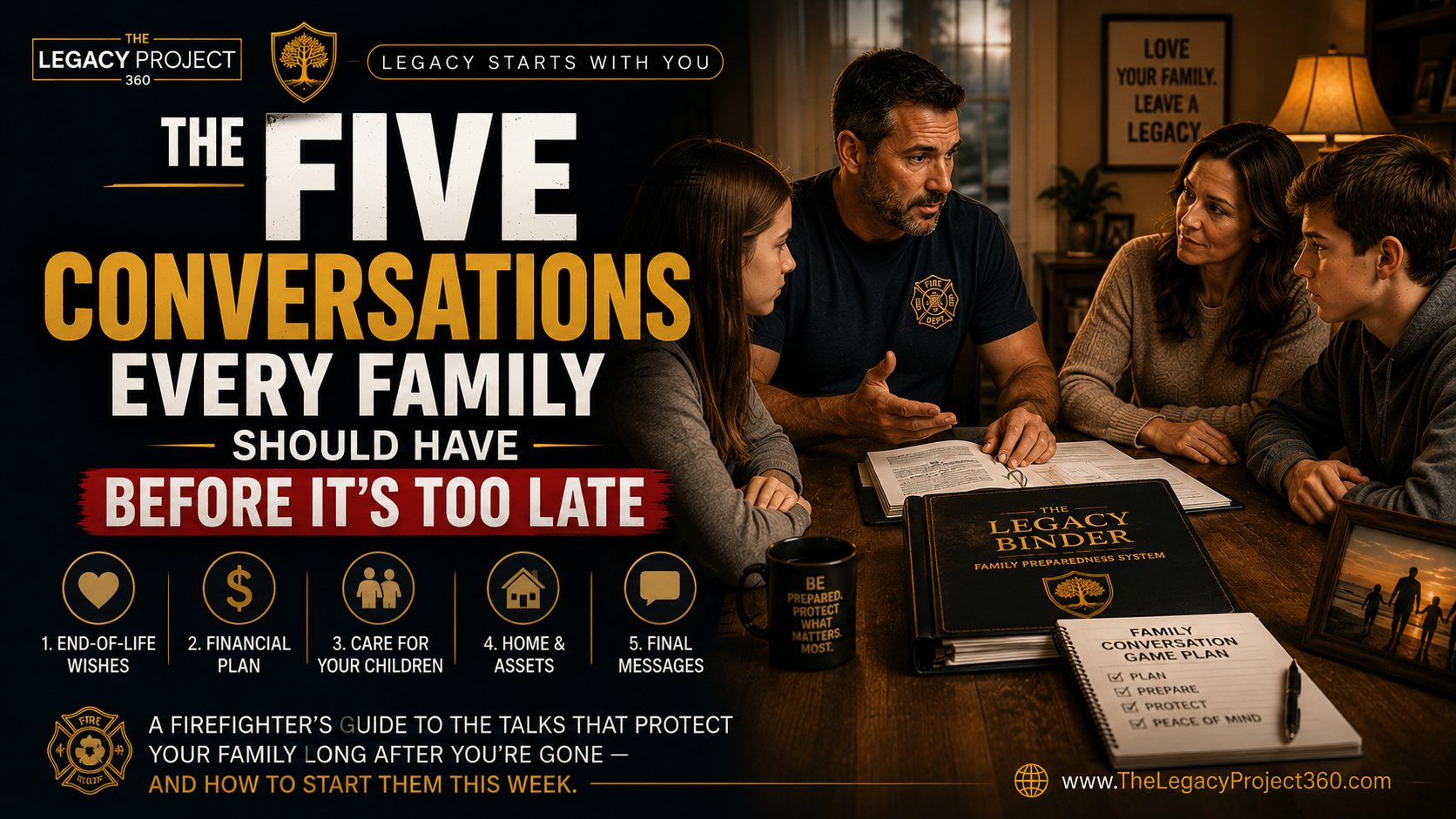
The Five Conversations
Here are the five talks. They build on each other. Take them one at a time.
1. The Faith & Values Conversation
Before anything else, your family needs to know what you believe and why. Not as a sermon, but as an inheritance. Tell them the story of your faith. Tell them what you''ve come to believe is true about God, about people, about how to live.
"Only be careful, and watch yourselves closely so that you do not forget the things your eyes have seen or let them fade from your heart as long as you live. Teach them to your children and to their children after them." — Deuteronomy 4:9
2. The Money Conversation
This is the one most families skip — and most regret skipping. You don''t need to disclose every account balance. You do need to make sure someone knows:
- Where the accounts are (banks, brokerages, retirement)
- Who the beneficiaries are
- Where the wills, trusts, and insurance policies live
- What debts exist and how they''re structured
- Who handles what if something happens
3. The Health & End-of-Life Conversation
This is the talk that, in my experience as a paramedic, prevents the most agony. Make your wishes known before you''re unable to speak them. Document them. Tell more than one person.
| Document | What it does | Where to keep it |
|---|---|---|
| Living Will | States your end-of-life care wishes | Binder + doctor''s file |
| Healthcare Proxy | Names who decides for you | Binder + proxy''s home |
| HIPAA Release | Lets loved ones access your records | Binder + hospital |
| DNR (if applicable) | Documents resuscitation choice | Refrigerator + binder |
Verbal wishes are not enough in a hospital. If it isn''t written down and accessible, the medical team is legally obligated to do everything possible — even when that''s not what you would have chosen.
4. The Stories Conversation
This is the one your kids and grandkids will treasure most. Where did you grow up? How did you meet their mom? What were the hardest years? What did you learn? What do you wish you''d known sooner?
Record it. Voice memos work. So does a notebook. So does sitting at the table on a Sunday afternoon while someone takes notes.
5. The "If Something Happens" Conversation
This is the practical one. Walk through it like a fire drill — calmly, clearly, without drama:
- Who do they call first?
- Where are the important documents?
- Who is the executor or trustee?
- What''s the plan for the house, the cars, the pets?
- What does enough look like for the family financially?
How to Start Tonight
You don''t need a four-hour family meeting. Pick one of the five. Pick the one that scares you the least. Tell your spouse or your oldest child:
"I''ve been thinking about something, and I want to make sure we''re on the same page. Can we talk for fifteen minutes after dinner?"
That''s it. That''s the entire ask. The hard part isn''t the conversation — it''s deciding to have it.
This week, pick one of the five and schedule a fifteen-minute conversation with your spouse or your oldest child. Put it on the calendar. Show up. That''s the win.
A Note on Tools
The reason I built The Legacy Binder was that even families who did have these conversations couldn''t find anything when it mattered. The conversation is step one. Putting it in writing — somewhere your family can actually find it — is step two. Both matter.
If you want a guided system that walks you through every one of these conversations and stores the answers in one place, The Legacy Binder was built for exactly that.
The Bottom Line
Your family doesn''t need you to be perfect. They need you to be prepared. Five conversations. One a week. By Father''s Day, you''ll have done more for your family''s future than 90% of the families I''ve worked with over the last twenty years.
The best time to have these conversations was ten years ago. The second best time is tonight.