

Your water heater holds more drinkable water than your entire pantry holds food. Most families never think about it until the tap stops. Hurricane Helene knocked out municipal water in Asheville, North Carolina starting September 27, 2024. Officials did not lift the boil-water advisory until November 18, more than 50 days later. By day three, store shelves were empty. By day five, parents were hauling pool water to flush toilets. Plenty of those families learned the hard way how to store water for emergencies after the fact.
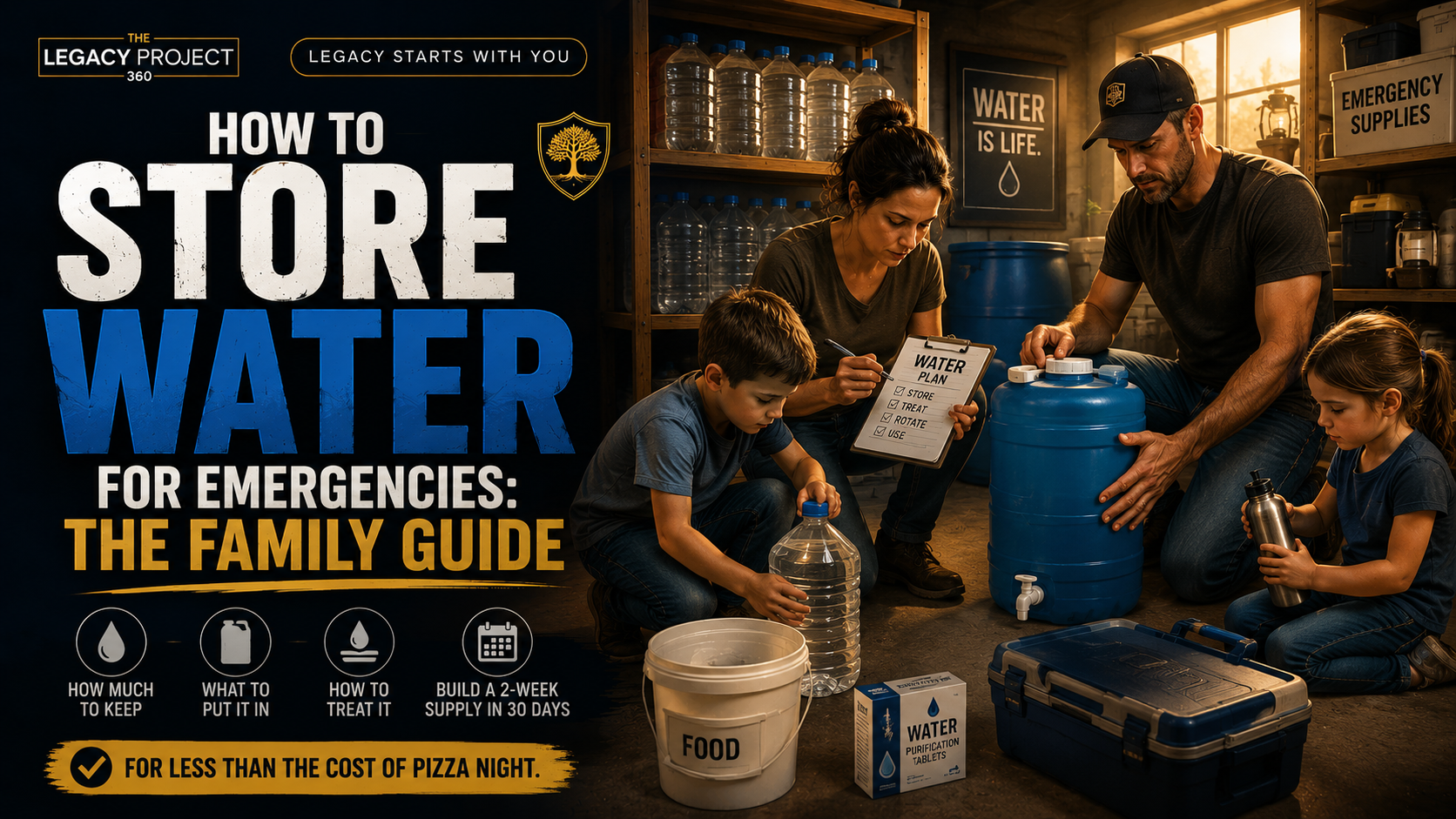
This post walks you through the right way to do it before the next storm. You will learn how much water your family needs, what to keep it in, where to put it, how to disinfect questionable water, and how to build a full two-week supply for around the cost of a couple of pizza nights.
What You'll Learn
- How Much Water Your Family Needs to Store for Emergencies
- What to Store Water In and What to Avoid
- Where to Store Emergency Water and How Long It Lasts
- How to Treat and Disinfect Water When the System Fails
- How to Build a Two-Week Water Supply in 30 Days
- Frequently Asked Questions
How Much Water Your Family Needs to Store for Emergencies
FEMA and Ready.gov give a clear baseline. Store one gallon of water per person per day. Half goes to drinking. Half goes to cooking and basic hygiene. The recommended supply is two weeks.
Run the math for a family of four. One gallon times four people times fourteen days equals 56 gallons. For a family of six, the number jumps to 84 gallons.
Some households need more.
- Hot climates push drinking needs above one gallon per person per day
- Pregnant or nursing mothers need more
- Sick or injured family members need more
- Children sometimes need extra for hygiene
- Pets need roughly one ounce of water per pound of body weight per day
A 70-pound dog drinks about half a gallon a day. Two dogs and a cat add another gallon to your daily total. A family of four with two dogs needs closer to 70 gallons for a two-week stretch, not 56.
If 70 gallons feels out of reach this week, start with a one-week target and build from there. The worst plan is no plan. If you have already built the two-week food supply covered in Emergency Food Storage 101, the water plan is the matching half of the same shelf.
What to Store Water In and What to Avoid
The container matters as much as the water. Bad containers leak, leach, or grow bacteria. Good containers sit on a shelf for years and do their job when you open the spigot.
Containers That Work
- Commercially sealed bottled water in original packaging
- Food-grade plastic water storage containers labeled HDPE 2 or PET 1
- Stackable water bricks designed for emergency storage
- Stainless steel containers rated for potable water
- Glass jars (heavy, breakable, fine for short-term and small volume)
- 55-gallon food-grade water barrels with a bung wrench and pump
The CDC recommends food-grade containers and warns against any container previously used for non-food substances. The label should read food grade or include a fork-and-knife symbol.
Containers to Skip
Do not reuse milk jugs. The plastic is thin, the seal is poor, and milk proteins are nearly impossible to scrub out. Bacteria love the residue.
Do not reuse fruit juice or soda bottles for long-term storage. Sugar residue feeds microbes. Two-liter soda bottles work for short-term emergency fills if rinsed thoroughly with hot water and air-dried, but they are a stopgap, not a system.
Skip used industrial containers, even if the label says food grade. You do not know the cleaning history. The risk is not worth the savings.
CALLOUT
THREE DAYS WITHOUT WATER AND YOUR BODY IS IN TROUBLE. TWO WEEKS WITHOUT A PLAN AND YOUR FAMILY IS IN CRISIS. THE FIX TAKES ONE SATURDAY AFTERNOON.
Where to Store Emergency Water and How Long It Lasts
Heat, light, and chemical fumes shorten water's useful life. Pick a spot with stable cool temperatures and no sunlight. A basement closet, an interior pantry, or a finished garage all work, as long as the spot does not freeze.
Storage Rules That Matter
- Keep water away from gasoline, pesticides, and cleaning chemicals (plastic is permeable to fumes over time)
- Do not store water containers directly on bare concrete (use a board, pallet, or cardboard underneath)
- Keep containers off freezing floors in winter (frozen water expands and splits seams)
- Rotate non-commercial water every six to twelve months
- Date every container with a permanent marker on the day you fill it
How Long Stored Water Lasts
The FDA does not require an expiration date on commercially bottled water because properly stored water does not spoil. The "best by" date on the bottle is about taste, not safety. The plastic itself starts to break down over a few years, especially in heat or sunlight.
Water you bottle yourself from clean tap should be rotated every six to twelve months. Pre-treated water from city systems carries a small chlorine residual, which fades over time, so refresh and refill on a schedule.
Hidden Sources Already in Your Home
Most homes hold 50 to 100 gallons of usable water you forget about.
- Hot water heater: 30 to 80 gallons of clean water once the gas or power is shut off and a hose is attached to the drain valve
- Toilet tanks (not bowls): 1 to 5 gallons of clean water each
- Ice cube trays and the freezer ice maker bin: a few gallons combined
- Pipes between meters and fixtures: 5 to 10 gallons in the average home
If municipal water is contaminated and a boil-water notice is in effect, treat any water from these sources as suspect until you have boiled or disinfected it.
How to Treat and Disinfect Water When the System Fails
What happens when the supply runs out and the tap is unsafe? You need a way to make water drinkable from imperfect sources. The CDC publishes three reliable methods.
Boiling
Boiling kills bacteria, viruses, and parasites. Bring water to a rolling boil for one minute. At elevations above 6,500 feet, boil for three minutes. Let it cool, then pour it back and forth between clean containers to add air and improve the flat taste.
Disinfecting With Bleach
Use regular unscented household chlorine bleach with 5 to 9 percent sodium hypochlorite. Per CDC guidance, add 8 drops (about 1/8 teaspoon) per gallon of clear water. Double to 16 drops per gallon if the water is cloudy. Stir, cover, and let it stand for 30 minutes. The water should have a faint chlorine smell. If it does not, repeat the dose and wait another 15 minutes.
Skip color-safe, scented, or splashless bleach. The added chemicals are not safe to drink.
Filtration
Portable filters work for biological contamination from creeks, rain barrels, and questionable wells. Look for filters certified to NSF/ANSI Standard 53 or 58, or filters meeting EPA microbiological purifier standards.
- Berkey-style gravity filters for the home
- Sawyer Squeeze, MSR, or Katadyn filters for go bags
- LifeStraw bottles for individual use
Filtration alone does not remove all viruses. Pair filtration with chemical disinfection if your source water is questionable.
What Not to Drink
Pool water and hot tub water work for flushing toilets and washing floors. Do not drink them. Pool chemicals are formulated for surface contact, not consumption. Floodwater is unsafe at any treatment level. Sewage, fuel, and chemical contamination make floodwater a hazard, not a resource.
How to Build a Two-Week Water Supply in 30 Days
Most families do not have 70 gallons of water sitting in the basement. Build the supply one week at a time.
Week 1: Drinking Water on Day One
- 4 to 6 cases of commercially bottled water (a 24-pack of 16.9 oz bottles holds about 3.2 gallons)
- 1 manual can opener and a one-week supply of paper plates and cups to reduce washing needs
- Date each case with a permanent marker
Week 2: Bulk Storage for Cooking and Hygiene
- 2 stackable seven-gallon water containers from any sporting goods store
- 1 food-grade five-gallon jug with a spigot
- Fill from your tap at home and date each container
Week 3: Treatment and Backup
- 1 bottle of unscented regular household bleach (the disinfection workhorse)
- 1 pack of water purification tablets for the go bag
- 1 gravity-fed home filter or a backpacking-style pump filter
Week 4: Family-Sized Reserve
- 1 fifty-five gallon food-grade barrel filled and treated with stabilized chlorine
- 1 bung wrench and a siphon pump
- 1 simple labeled chart on the wall showing fill date and rotation date
In thirty days you move from no water plan to a system holding your family for two full weeks. Total cost lands between 150 and 250 dollars depending on container choice. Less than four months of streaming services.
For the documents and contact information your family needs alongside the water, see The Family Documents You Need Organized Before a Crisis Hits and the Legacy Binder Family Preparedness System at thelegacybinder.com.
Frequently Asked Questions
How long does emergency water storage last?
Commercially bottled water has no required expiration date for safety, per FDA rules. Taste declines over a few years as plastic breaks down, especially in heat or sunlight. Tap water you bottle yourself should be rotated every six to twelve months because the residual chlorine fades over time.
Is it safe to drink water from your hot water heater?
Yes, if the tank has been maintained and the water is drained from the bottom valve into a clean container. Most heaters hold 30 to 80 gallons. Shut off the power or gas first, then attach a hose to the drain valve. If a boil-water notice is in effect, treat the drained water as suspect until you have boiled or disinfected it.
How do you purify water in an emergency without bleach?
Boil water at a rolling boil for one minute, or three minutes above 6,500 feet. Boiling kills bacteria, viruses, and parasites and needs no chemicals. A portable backpacking filter rated to NSF Standard 53 handles biological contamination if you have no fuel for boiling. Pair filtration with iodine or chlorine dioxide tablets for full safety against viruses.
Is it safe to store water in old milk jugs or two-liter soda bottles?
Skip milk jugs. The plastic is thin, the seals are weak, and milk residue grows bacteria fast. Two-liter soda bottles work as a short-term option if rinsed thoroughly with hot water and air-dried before filling. For long-term storage, buy food-grade containers designed for water.
How much water does a family of four need for two weeks?
Fifty-six gallons at the FEMA baseline of one gallon per person per day. Add more for pets, hot climates, pregnancy, and illness. A realistic family-of-four target with two dogs is closer to 70 gallons.
Conclusion
Water disappears first when emergencies hit. Food, fuel, and patience all come after. Knowing how to store water for emergencies turns a frightening situation into a manageable one. Your kids drink clean water while the neighborhood stands in line at distribution sites. You cook, bathe, and flush toilets without rationing. The plan takes one trip to the store and a few small additions over the next month. The next post in this series covers how to handle the emotional conversation most families avoid until it is too late.
Once your water and food are in place, the next gap most families miss is documents. The Legacy Binder Family Preparedness System keeps the medical, financial, and legal information your family needs in one organized place when the taps run dry and the lights go out. See the full system at thelegacybinder.com.
Written by Paul T. Brewer, The Legacy Project 360.