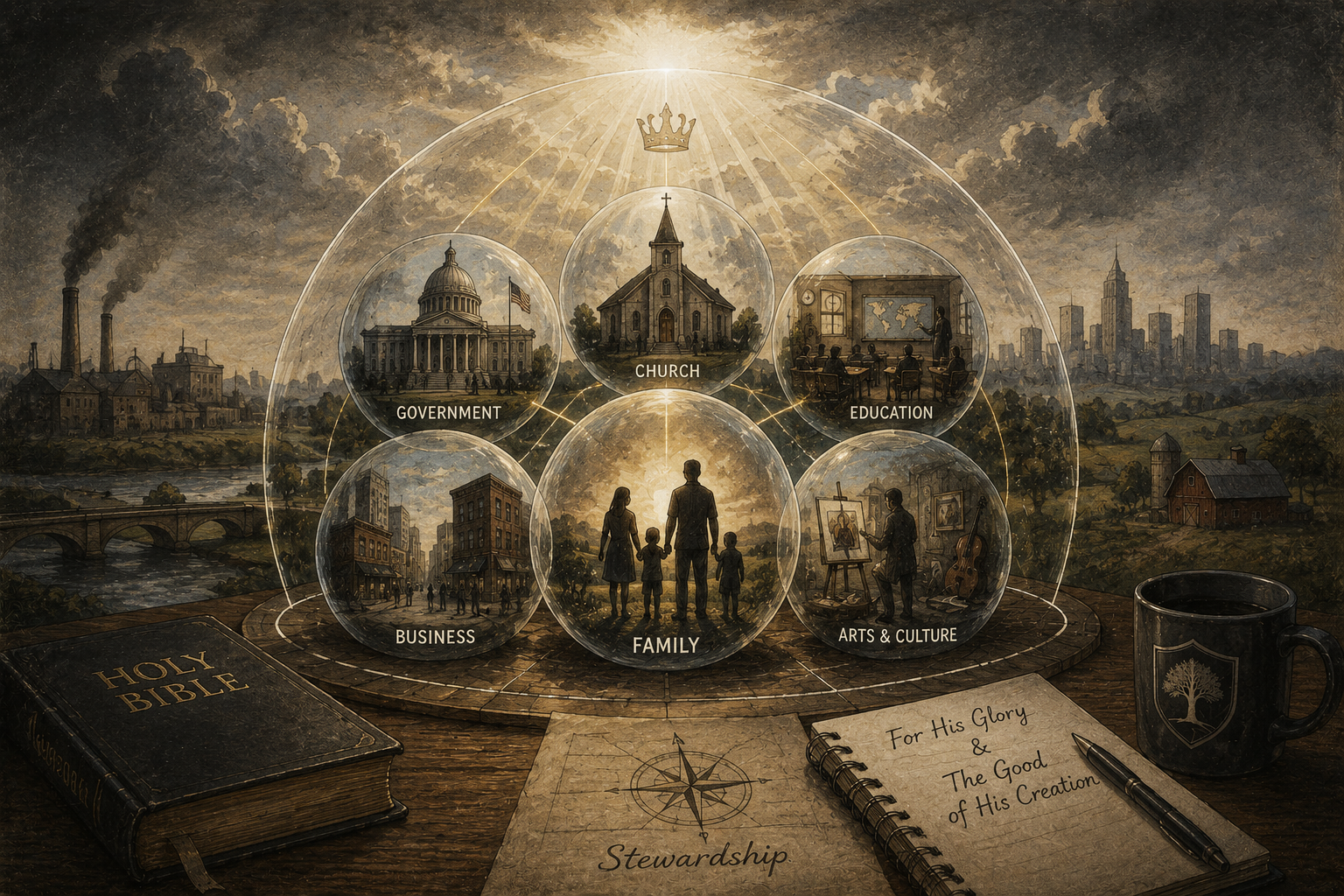
God is sovereign over all of life, but He has assigned different responsibilities to different institutions. The family is not the state. The church is not the government. The school is not the home. Each sphere has real authority, but no sphere has ultimate authority. This framework protects against both the idea that God only cares about church life and the danger that any human institution should control everything.
What You'll Learn
- The Core Idea
What Kuyper Actually Said
The Major Spheres
Why the State Matters but Has Limits
How This Connects to Family and Legacy
The South Africa Problem: A Serious Warning
How to Apply This
For Your Life and Family
The Core Idea
Abraham Kuyper was a Dutch theologian, pastor, journalist, and prime minister of the Netherlands from 1901 to 1905. He articulated a theological and philosophical framework emphasizing the distinct, God-ordained authorities within various spheres of life, such as the church, state, family, and education.
The principle is simple: God is sovereign over every area of life, but He has designed different areas to have their own proper authority, purpose, limits, and responsibilities.
This is not a complicated idea. It is practical and grounded in how God made the world to work.
The family has authority over children. The church has authority over doctrine. The state has authority over civil justice. The school has authority over education. The business has authority over commerce. Each operates in its own sphere.
Because Christ owns all of it, no human institution gets to own all of it.
What Kuyper Actually Said
Kuyper championed the principle that Christ claims sovereignty over "every square inch" of life. The deeper meaning is not merely that Christians should care about politics, education, art, economics, and family life. It means every part of creation belongs to God, but each part must operate according to God's design for that part.
Kuyper was answering a specific problem in his time. On one side, some religious people said, "God only cares about church stuff. Everything else is secular." On the other side, some political movements said, "Because God cares about everything, we should control everything through the state."
Kuyper rejected both errors.
He insisted that Christ is Lord over all things. But that does not mean the church should run the government. It does not mean the government should run the family. It does not mean the school should replace parents. It does not mean business should treat workers like machines.
Each sphere belongs to God. Each sphere has limits.
The Major Spheres
Think of society like a set of God-designed jurisdictions. Each has real authority, but limited authority.
The family has authority over children, household formation, moral training, inheritance, daily rhythms, and covenantal responsibility. Parents teach. Parents discipline. Parents set the values and spiritual direction of the home. No other institution can do this.
The church has authority to preach the Word, administer worship, disciple believers, correct doctrine, care for souls, and call people to repentance. The church forms people through teaching, worship, community, and the call to holiness. The state cannot do this.
The state has authority to uphold public justice, punish evil, protect rights, restrain violence, and maintain civil order. Society, family, and household lead their own independent existence, an existence that is neither created, nor maintained, nor regulated by the government.
Education has authority to form minds, pursue truth, transmit knowledge, and train wisdom. But parents and worldview commitments matter deeply in this process. A school is not a parent.
Business and economics have authority around production, trade, labor, stewardship, and value creation. But they must not treat people as machines or reduce workers to profit margins.
Art, science, media, and culture each have their own God-given role. But each becomes corrupted when detached from truth, beauty, goodness, and accountability.
The overlapping point is important. These spheres do overlap. They interact. The point is not that they never intersect. The point is that they should not swallow each other.
Why the State Matters but Has Limits
For conservative Christians, this is where sphere sovereignty becomes politically useful.
Kuyper advocated for a society where diverse domains operate freely within their God-given jurisdictions, championing the principle that Christ claims sovereignty over "every square inch" of life, while his vision critiques the overreach of state power into areas like the church and education.
Kuyper warned against the state becoming like an "octopus" that stifles the whole of life. He wrote that the state may never become an octopus which stifles the whole of life, and that neither the life of science nor art, nor agriculture, nor industry, nor commerce, nor navigation, nor the family, nor human relationship may be coerced to suit itself to the grace of the government.
This is sharper than saying, "Small government good, big government bad."
A Kuyperian view says: Government should be strong where God assigned it authority, and restrained where God did not.
The government should protect children from abuse. It should not replace parents.
The government should punish crime. It should not redefine morality as whatever the regime prefers.
The government should protect religious liberty. It should not manage the church.
The government should secure public order. It should not become the source of meaning, identity, and salvation.
This matters to you because it gives a framework for what you should demand of government and what you should never ask government to do.
How This Connects to Family and Legacy
You are building a family legacy. You are thinking about how to pass faith to your children. You are planning for your family's future.
Sphere sovereignty protects your family.
It says that the primary responsibility for your children's moral formation rests with you, not with schools or the state. Your home is not a satellite office of the Department of Education. Your family is not an extension of the government.
It says that the church has a responsibility to disciple your family that the state cannot fulfill. You need a church. Your children need a church. The church is not optional infrastructure.
It says that you have rights to direct the education of your children. You choose the school or homeschool. You teach your children your values. The state is not the ultimate arbiter of what your children believe.
It says that your marriage is a covenant, not a contract managed by the state. Your family is under God's authority first.
This is why many Christians are concerned about state overreach into family life. It is not because Christians hate government. It is because they understand that God designed the family as the primary place where children are formed, faith is transmitted, and life direction is set.
The South Africa Problem: A Serious Warning
Here is where you must slow down and think carefully.
The concept of sphere sovereignty as postulated by Abraham Kuyper was used in an ambiguous manner in the history of South Africa, specifically during the time of apartheid. On one hand, it is associated with the justification of apartheid, which is particularly evident in a 1976 document. On the other hand, it is also associated with Black Liberation Theology, specifically by Alan Boesak, who resisted apartheid. The problem is that both these perspectives reduce the complexity of reality to race.
This is critical to understand.
Apartheid supporters misused sphere sovereignty to justify racial separation. They treated race as a sovereign sphere and said that different races had different spheres and should be kept separate. They distorted Kuyper's framework to defend segregation and oppression.
But here is the point: According to Kuyper sphere sovereignty meant that no aspect of reality could be an absolute point of departure to structure the whole and each aspect is sovereign in its own domain. Thus, race or any other aspect cannot be the norm to structure reality.
The irreducibility of Kuyper's sphere sovereignty and the universal authority of God were compromised with the rise of apartheid in South African because reality was reduced to race.
What Kuyper actually believed was different. Kuyper stressed that "The wall of separation has been demolished by Christ, the lines of distinction have not been abolished." The former is as important as the latter, but apartheid stressed the latter (the lines of distinction) and ignored the former (separation demolished). Apartheid is a misrepresentation of what Kuyper intended.
Kuyper never defined spheres by race. Unfortunately, Kuyper was not alive to police this translation of his legacy, which was implemented 28 years after his death. Some argue that Kuyper still bears partial responsibility because of his affirmation of the Boer treatment of Black Africans, but the misuse of sphere sovereignty by apartheid supporters bends Kuyper's idea to a purpose he never articulated and likely never intended.
Sphere sovereignty is not an excuse for neglect, oppression, racism, abuse, or institutional self-protection.
Any theology of separate spheres can be twisted into defending injustice if you forget that every sphere remains under the righteousness of God. Every sphere is limited. Every sphere is accountable to God.
A family cannot say, "The state has no right to interfere," while abusing children.
A church cannot say, "We govern ourselves," while hiding crimes.
A business cannot say, "This is our sphere," while exploiting workers.
A government cannot say, "We serve justice," while crushing conscience.
The beauty of Kuyper's actual thought is that it protects every sphere from tyranny. It also holds every sphere accountable to God's justice. It says no sphere is absolute. It says Christ is sovereign over all.
How to Apply This
If something is broken, ask three questions.
First, which sphere has primary responsibility? If a child is undisciplined, start with the family. If doctrine is corrupt, start with the church. If crime is rising, look at civil justice. If workers are exploited, look at business, law, and moral formation. If students are being propagandized, look at parents, schools, churches, curriculum, and state policy.
Second, which sphere is overreaching? Is the state acting like a parent? Is the school acting like a church? Is the business acting like a family? Is the church acting like a political party? Is the media acting like a priesthood?
Third, what would restored order look like? Not merely, "How do we win?" But, "How do we put responsibility back where God designed it to belong?"
That is the Kuyperian move.
For Your Life and Family
You probably sense that something has broken down in society. You see the state expanding into family life. You see schools substituting for parental formation. You see the church weakening. You see business becoming amoral. You see politics becoming everything.
Sphere sovereignty gives you a framework to understand why this happened and what to do about it.
It is not mainly a political problem. It is an institutional problem.
Government has a remedial role to intervene when there are conflicts between spheres and corruption within them, subject to certain principles and limits. But government cannot rebuild the family. Government cannot plant churches. Government cannot form your children's character.
Those responsibilities rest with you.
The culture did not fall because the wrong people won elections. The culture broke down because spheres became weak. Families weakened. Churches weakened. Schools compromised. The void was filled by state power, corporate power, and entertainment.
Rebuilding America, your state, or your community is not mainly a top-down project.
It is a household project.
It is a church project.
It is a school project.
It is a business ethics project.
It is a discipleship project.
You strengthen your family. You build a strong marriage. You teach your children. You build a household rhythm and spiritual legacy. You participate in a church that actually disciples people. You engage in your community.
These are the spheres where you have most power to shape culture.
And here is the hard truth: If these spheres cannot hold their own without political victory, then political victory will not save them.
Politics can restrain evil.
Politics can protect liberty.
Politics can reward good behavior.
But politics cannot replace fathers, mothers, pastors, mentors, neighbors, teachers, and churches.
If you want a godly culture, you build it from the bottom up through families, churches, schools, and communities. You do not wait for the state to hand it to you.
This is why your family legacy matters.
This is why your marriage matters.
This is why your parenting matters.
This is why your church matters.
This is why your community matters.
You are not just raising children. You are raising the next generation of fathers, mothers, leaders, workers, and citizens. You are planting seeds in households and churches that will grow for decades.
You start with what you can control. You build what God has called you to build.
Sphere sovereignty teaches you that God has put enormous power in your hands, the hands of your church, the hands of your family. You do not need to wait for someone else to fix things.
Written by Paul T. Brewer, The Legacy Project 360
Your family's future matters. The Legacy Binder helps you organize the practical and spiritual dimensions of your family's legacy. At thelegacybinder.com, you can access tools to document your values, your faith, your family story, and your wishes for those you love. Start building your family's legacy today.