
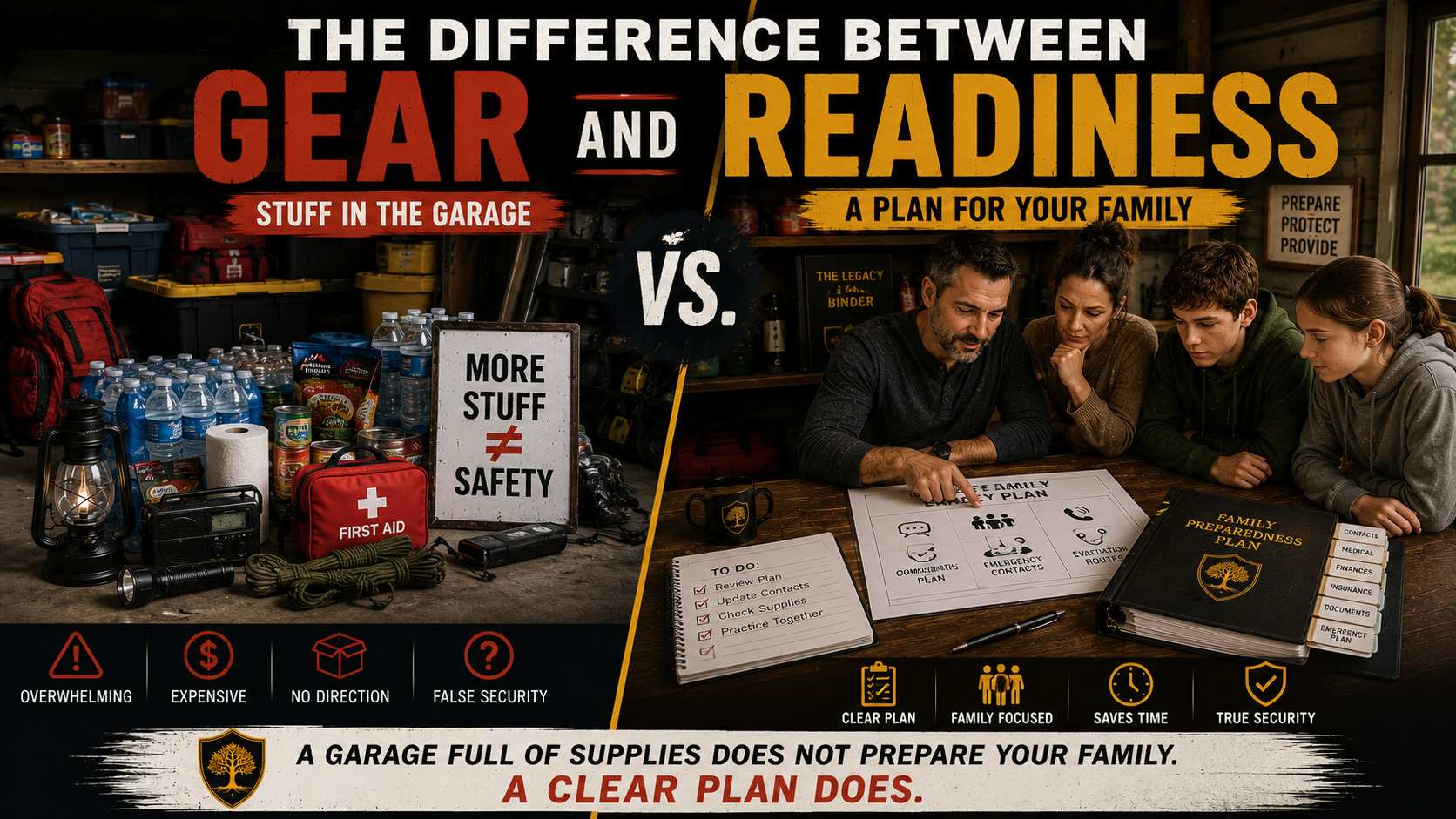
You can have a garage full of emergency supplies and still fall apart when something goes wrong. After two decades in the fire service, I have seen this pattern clearly. Families freeze not because they lacked gear, but because they had no plan, no practice, and no mental preparation for the moment chaos arrived.
Generators sat unused. First aid kits stayed sealed. Food storage sat untouched because nobody knew how to prepare it. The supplies were there. The readiness was not.
Gear supports your preparedness. It does not create it. Let me show you the difference.
What You'll Learn
Why stockpiling supplies creates false security
What a real emergency plan actually looks like
Which basic skills protect your family most
How community relationships fill gaps gear cannot
How to build mental readiness that holds everything together
"By failing to prepare, you are preparing to fail." — Benjamin Franklin
Gear Does Not Equal Readiness
Most people feel accomplished when the shelves are stocked. Boxes checked. Supplies purchased. The problem is that gear does not fix hesitation, panic, or confusion.
I have met families with entire rooms dedicated to emergency supplies who still struggled when a real crisis hit. Their response was disorganized. Their equipment was misplaced or unfamiliar. Their decisions slowed down at the exact moment speed mattered most.
Clutter makes it worse. When every second counts, searching for the right item or figuring out how to operate something you have never touched before costs time you do not have.
The goal is not to have the most gear. The goal is to have the right gear, organized, familiar, and ready to use.
Readiness is not measured by what you own. It is measured by what you know and what you can do.
Real Preparedness Has Three Parts
A Simple Plan Everyone Knows
Complex plans fail under stress. Simple ones hold. Your family emergency plan should answer three questions that every member of your household can recite without looking anything up:
What do we do first when this type of emergency happens?
Who is responsible for what?
Where do we meet if we get separated?
Assign roles. Keep the language plain. When everyone knows their part, decisions become automatic and panic loses its grip.
Knowledge Removes Hesitation
Basic first aid knowledge is one of the highest-value investments your family can make. Knowing how to stop bleeding, treat a burn, or perform CPR does not just save lives. It keeps you calm because you are responding with purpose rather than reacting blindly.
You do not need to become a medical professional. You need enough foundational skill to act with confidence in the first critical minutes.
The American Red Cross offers basic first aid and CPR courses at redcross.org. Most courses take four hours or less.
Practice Turns Plans Into Instincts
Reading a plan is not the same as knowing it. Walk your family through a power outage scenario. Talk through what to do if someone gets injured. Run a fire drill. Repetition converts a written plan into an instinctive response.
Families that practice even once a year perform measurably better when a real emergency arrives.
Schedule a family emergency drill this month. Pick a scenario, talk through your response step by step, and assign roles. This single practice session changes how your family responds when it matters.
Community Relationships Matter As Much As Supplies
No amount of gear replaces the human element. Your neighbors, your church community, and your local relationships are part of your preparedness system whether you have thought about them that way or not.
Research consistently shows that neighborhoods with strong social ties respond faster and recover more quickly from disasters. FEMA's community preparedness resources reinforce this directly. During a power outage, neighbors who know each other share generators, check on the elderly, and coordinate without being asked. During a flood or wildfire, those same relationships become the difference between organized response and chaos.
Three things strong community connections provide that gear cannot:
Emotional support that reduces panic and improves decision-making
Shared resources that extend what any one family can cover alone
Coordinated action that makes the whole neighborhood more resilient than any individual household
Building these relationships does not require a formal program. It requires knowing your neighbors' names, checking in occasionally, and being the kind of person who shows up. That investment pays returns during every type of emergency.
A prepared family in an unprepared community loses advantage. Community relationships are not optional in real preparedness.
Mental Readiness Holds Everything Together
Your mindset during an emergency shapes every decision you make. Fear and panic cloud judgment. A prepared mind assesses, prioritizes, and acts.
Building mental readiness is a skill, and like every skill, it improves with practice.
Three techniques worth building into your family routine:
Visualization. Walk through emergency scenarios in your mind before they happen. Picture yourself staying calm, recalling your plan, and moving through the steps. Athletes use this technique before competition for good reason. It works.
Breathing. Slow, intentional breathing activates your parasympathetic nervous system, which counters the panic response. When chaos hits, your first move is to breathe deliberately. Three slow deep breaths before acting is a tool that costs nothing and works immediately.
Regular discussion. Talk through your emergency plans with your family at least twice a year. Ask questions. Update roles as your kids get older. Familiarity reduces the mental load when it matters most.
Mental readiness is not a personality trait some people have and others do not. It is a skill your entire family can build over time.
How Do You Know If Your Family Is Actually Ready?
Ask yourself whether every member of your household can answer these three questions without looking anything up: What do we do first in an emergency? Who handles what? Where do we meet if separated? If the answers are unclear, you have planning work to do regardless of how much gear you own.
Basic skills every family member should know include first aid, CPR, how to shut off your home's water and gas, and how to use every piece of emergency equipment you own. If something in your garage has never been turned on, turn it on this weekend. Familiarity with your own gear is non-negotiable.
Where to Go From Here
Supplies matter. Buy them, organize them, and know where they are. But a stocked shelf does not prepare your family for the moment something goes wrong.
A clear plan does. Practiced skills do. Strong relationships do. A calm, trained mind does.
Build those four things alongside your gear and your family will be ready in a way that no amount of equipment can replicate on its own.
This week, write down your family's three-question emergency plan. Who does what. Where you meet. Share it with every member of your household. Then schedule a practice drill for next month. That is the foundation of real readiness.