

I have sat with families after they lost everything. When Hurricane Helene tore through western North Carolina in September 2024, it killed over 250 people and caused nearly 79 billion dollars in damage. The families I spoke with afterward all said the same thing in different words. They thought they had time. Most of them went to church. Most of them owned Bibles. None of them had connected what they read on Sunday with what hit them on Friday.
That is what this post is about. Your Bible has more to say about family preparedness than you probably realize. And it does not ask you to choose between faith and preparation. It demands both.
Preparedness Is Biblical, Not Fearful
Some Christians were taught that storing food, building an emergency fund, or organizing documents reveals a heart running on anxiety instead of faith. The verses they quote sound right. Take no thought for your life. Look at the birds of the air. But they are reading those verses without context.
Paul wrote something sharper to Timothy. "Anyone who does not provide for their relatives, and especially for their own household, has denied the faith and is worse than an unbeliever" (1 Timothy 5:8 NIV). That is not a gentle suggestion. That is a definition of what the faith requires.
"Anyone who does not provide for their relatives, and especially for their own household, has denied the faith and is worse than an unbeliever." — 1 Timothy 5:8 (NIV)
Solomon said the same truth twice in one book, which in Hebrew means underline it. "The prudent see danger and take refuge, but the simple keep going and pay the penalty" (Proverbs 22:3 NIV). Foresight and planning are wisdom. Failure to prepare is folly.
Faith and preparation are not opposites. They are the same posture from two angles. You trust God for the outcome and you steward what He put in front of you. You pray for protection and you maintain a smoke detector. Both, not either.
Faith does not replace action. Faith fuels action. Pray, plan, and prepare in the same week.
Seven Verses Every Christian Home Should Know
Below are the scriptures that shifted how I see preparedness. Read them with a pen in your hand.
1 Timothy 5:8 (NIV)
"Anyone who does not provide for their relatives, and especially for their own household, has denied the faith and is worse than an unbeliever."
This is the foundation. Provision is not optional. Scripture treats the failure to provide as a denial of faith itself.
Proverbs 22:3 (NIV)
"The prudent see danger and take refuge, but the simple keep going and pay the penalty."
The practical heart of biblical preparedness. The prudent person sees what is coming and acts. No middle ground.
Proverbs 6:6-8 (NIV)
"Go to the ant, you sluggard. Consider its ways and be wise! It has no commander, no overseer or ruler, yet it stores its provisions in summer and gathers its food at harvest."
God uses an insect as a teaching object. The ant prepares because storing during seasons of plenty is wisdom built into creation itself.
Proverbs 21:20 (NIV)
"The wise store up choice food and olive oil, but fools gulp theirs down."
Old Testament wisdom names food storage as a mark of the wise household. It covers more than emergency preparedness. It speaks to the habit of saving instead of consuming everything you earn the moment you earn it.
Genesis 41:35-36 (NIV)
"They should collect all the food of these good years that are coming and store up the grain under the authority of Pharaoh, to be kept in the cities for food. This food should be held in reserve for the country, to be used during the seven years of famine that will come upon Egypt, so that the country may not be ruined by the famine."
Joseph laid out a seven-year preparedness plan for an entire nation. God called him faithful for it. Biblical leadership includes long-term reserve building for the families under your care.
Luke 14:28-30 (NIV)
"Suppose one of you wants to build a tower. Won't you first sit down and estimate the cost to see if you have enough money to complete it? For if you lay the foundation and are not able to finish it, everyone who sees it will ridicule you."
Jesus uses planning as a metaphor for following Him. He assumes a Christian counts the cost before starting. Preparedness is the baseline of any serious work.
Proverbs 13:22 (NIV)
"A good person leaves an inheritance for their children's children, but a sinner's wealth is stored up for the righteous."
Biblical preparedness does not stop with you. It stretches three generations forward. A good mother or father leaves enough behind to bless grandchildren they have never met.
Preparedness is not the opposite of faith. Preparedness is what faith looks like when you love the people God gave you.
Three People Who Got It Right
Scripture gives more than verses. It gives faces. Three figures show what biblical preparedness looks like under real pressure.
Noah: Building Before the Storm
Genesis 6 describes Noah receiving instruction from God to build an ark before a single drop of rain fell. Hebrews 11:7 names his obedience as faith. "By faith Noah, when warned about things not yet seen, in holy fear built an ark to save his family" (Hebrews 11:7 NIV). Faith and preparation moved together. Noah did not pray and wait. He prayed and built.
God warns through Scripture, through wisdom, through history, and through the firefighter sitting next to your kid's soccer practice. Hearing the warning is half the work. Building the ark is the other half.
Joseph: Storing for the Whole Nation
Genesis 41 describes Joseph interpreting Pharaoh's dream and proposing a seven-year plan to store grain during years of plenty for years of famine. The plan saved Egypt and surrounding nations, including Joseph's own family. Joseph models long-term thinking inside a culture of immediate consumption.
When Hurricane Helene knocked out potable water to Asheville for 53 days, the families with stored water were the ones sharing with neighbors. Joseph's pattern played out in real time.
The Proverbs 31 Woman: Practical Daily Stewardship
Proverbs 31 paints the picture of a working mother who runs her household like a small business. "She is not afraid of the snow for her household, for all of them are clothed in scarlet" (Proverbs 31:21 NIV). She is not afraid of the snow because she already prepared for it. The chapter lists her grocery planning, financial management, real estate decisions, and clothing the household for the season.
Scripture honors her by name. The qualities listed apply equally to husbands, fathers, and any adult running a home. Preparation is not gendered. It is wise.
The people in Scripture who prepared were called faithful, not fearful. Your preparation is part of your testimony.
How to Lead Your Family This Week
You do not need a sermon series. You need a Sunday afternoon and a willingness to lead.
Step One: Open the Bible Together
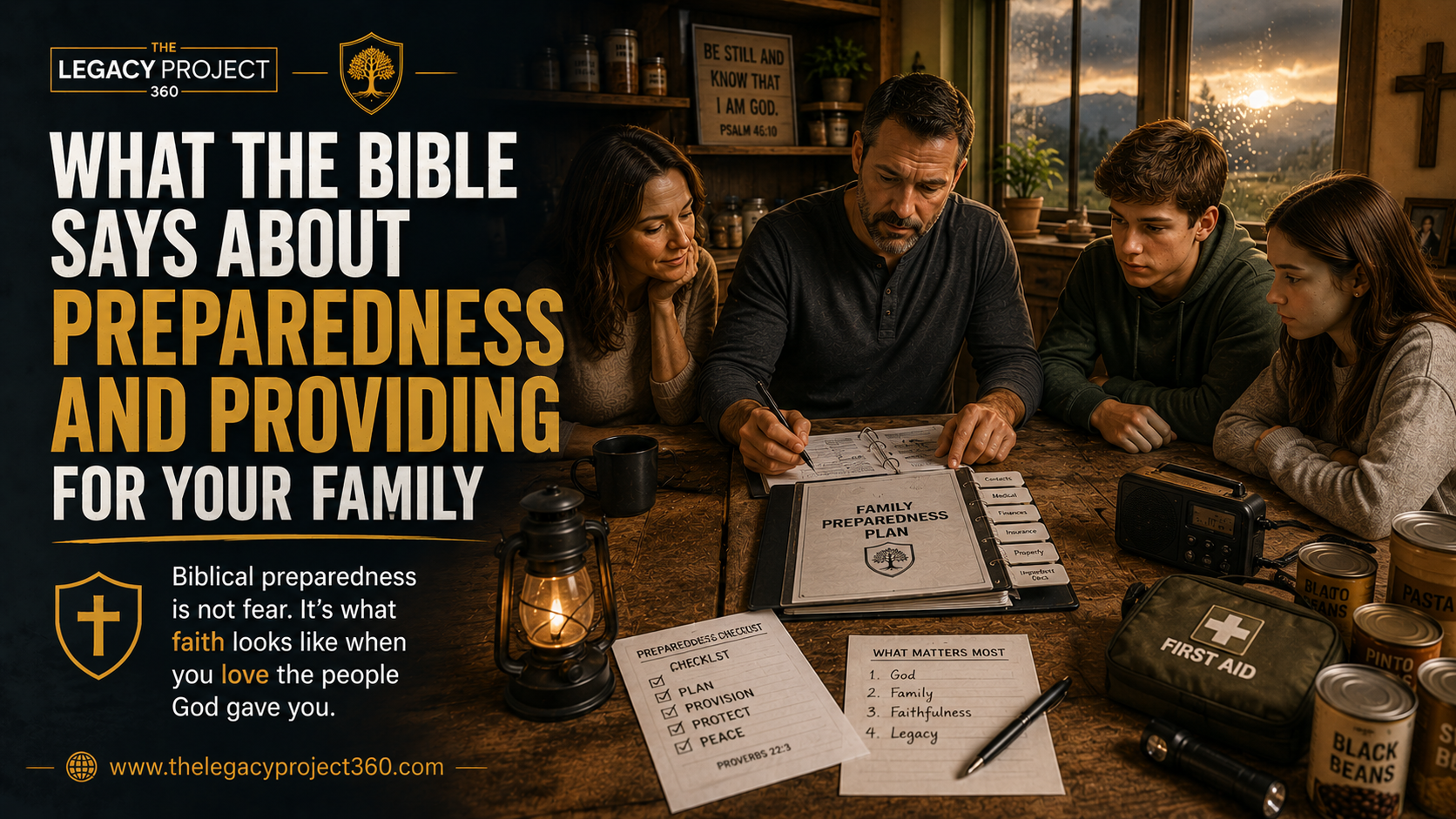
Sit your spouse and kids around the kitchen table for twenty minutes. Read 1 Timothy 5:8 and Proverbs 22:3 out loud. Ask one question. "Are we doing this?" The honest answer reveals every gap in your home's preparedness.
Step Two: Build the Three-Layer Plan
Biblical preparedness covers three layers, in this order. Spiritual readiness, household provision, and legacy continuity. Pray with your spouse. Ask God to give you wisdom on what your specific household needs.
Step Three: Pick One Action and Finish It
Most families fail at preparedness because they try everything at once. Apply Scripture's principle. Pick one action and finish it this week.
Buy a fire-rated home safe and put your essential documents in it
Build a 72-hour go bag for each household member
Open an emergency fund with one month of expenses
Write your will, even the simple version from a service like Rocket Lawyer or LegalZoom
Have the conversation with your kids about what to do if you are gone
Step Four: Pass It On
Proverbs 13:22 makes inheritance a three-generation project. Document what you set up. Tell your adult children where it lives. Show your spouse how to access every account. The work is not finished when the binder is full. The work is finished when the next generation has the keys.
This week, read 1 Timothy 5:8 and Proverbs 22:3 with your family and answer one question together. "Are we doing this?"
Your Questions Answered
Does the Bible specifically command Christians to prepare for emergencies?
The Bible does not use the word "emergency preparedness" but it commands the behaviors throughout. Provision for family is required. Foresight is wisdom. Storing during seasons of plenty is praised. Counting the cost before starting any serious work is taught by Jesus. Scripture gives a full preparedness mandate without using modern vocabulary.
How do I balance trusting God with stockpiling supplies?
Trust and stewardship are not opposites. Noah trusted God and built an ark. Joseph trusted God and stored seven years of grain. The Proverbs 31 woman trusted God and clothed her household for the snow. Faith never replaces action. Faith fuels action.
What if my spouse thinks preparedness is paranoid or unspiritual?
Open the Bible together. Read 1 Timothy 5:8 and ask the question out loud. Most pushback dissolves when Scripture is on the table instead of a YouTube video. Biblical preparedness is leadership, not anxiety. Frame it as obedience to the household provision verse and watch the conversation shift.
Do not let disagreement about preparedness sit unaddressed. 1 Timothy 5:8 makes household provision a non-negotiable. Have the conversation this week.
Where do I start if I have nothing in place?
Start with the document everyone needs and almost nobody has organized. Pull every birth certificate and Social Security card in your home, scan them with your phone, and save them to one cloud folder this afternoon. Then add a fire-rated safe and a 72-hour go bag over the next two weekends. Three weekends total is enough to outpace 70 percent of American households on the basics.
Should my church be involved?
Yes. Fifty-nine percent of churches had no formal disaster preparedness plan in place before Hurricane Katrina, and only 24 percent had comprehensive plans. If your church does not have a preparedness ministry for elderly members, single parents, and families with special needs children, ask your pastor about starting one. Scripture treats the church as a household of households.
The Work Ahead
Your Bible has more to say about family preparedness than most pulpits cover in a year. Provision is required. Foresight is praised. Storing during the season of plenty is wise. Counting the cost is the baseline of any serious work.
The pattern shows up in Noah, Joseph, the Proverbs 31 wife, and Paul writing to Timothy. None of them treated preparation as a lack of faith. They treated it as faith with hands and feet.
You can do the same.
This weekend, pull one essential document from your home, scan it with your phone, and save it to a cloud folder. That is your first step.