
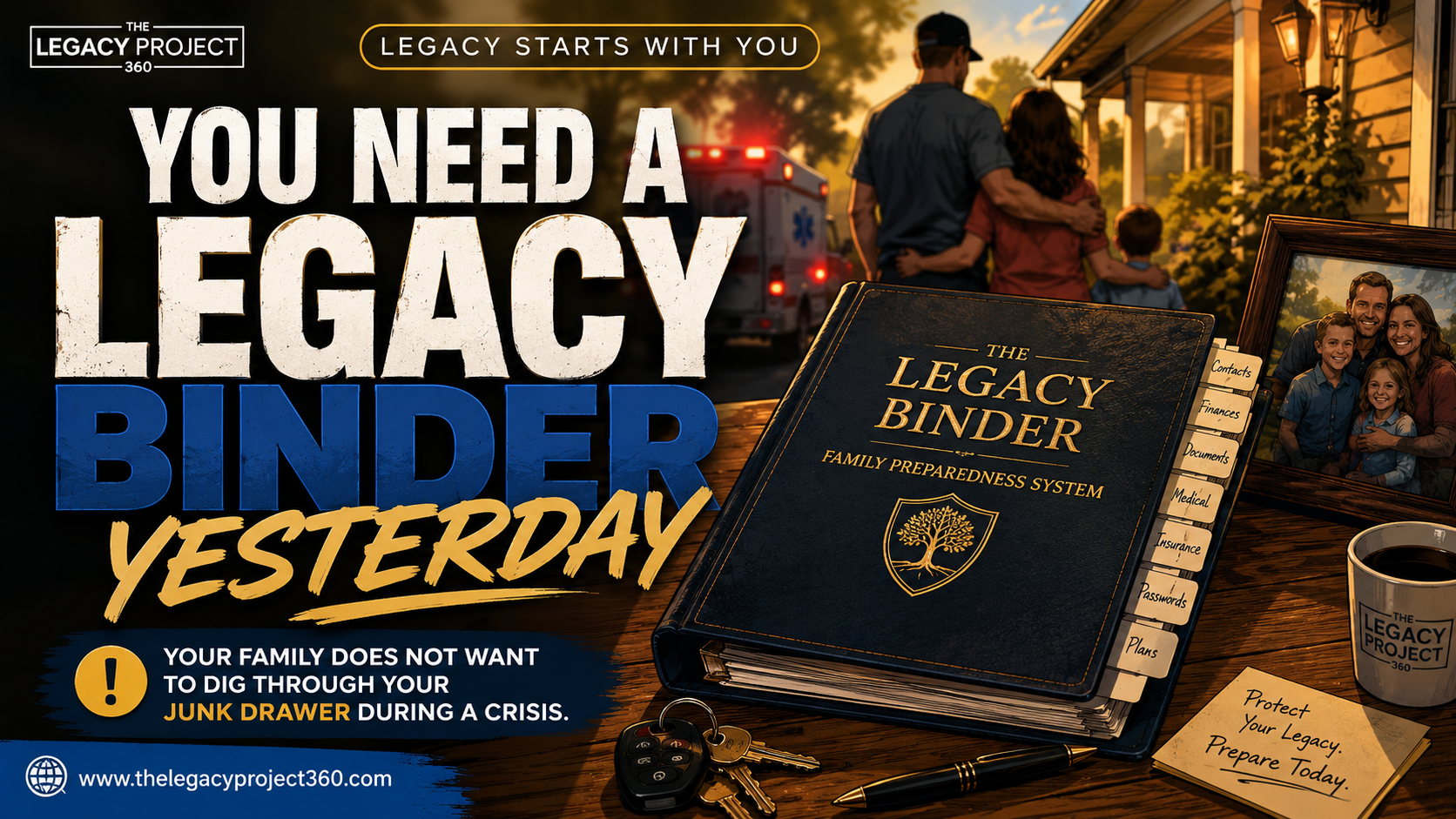
Your family does not want to dig through your junk drawer during a crisis.
They do not want to guess which bank accounts exist. They do not want to hunt for passwords while managing grief. They do not want to play medication trivia while someone is in the emergency room.
But that is exactly what happens when families have to search for critical information during the worst moments of their lives.
I know because I have watched it happen.
For nearly twenty-five years, I have worked as a firefighter paramedic. I have responded to thousands of calls. Some were routine. Some were chaotic. Some changed families forever. What nearly every single call has in common is one brutal moment.
Someone asks: "Where is the information we need?"
And nobody knows.
A family member is sick, badly injured, or gone. Emotions are high. Decisions need to happen fast. Then the questions pour in.
Where are the medical documents? Who has the passwords? What insurance exists? Did they ever write down their wishes?
Most of the time, the answer is silence.
This problem is not because families do not care. It is not because people lack discipline. It is because life moves faster than systems. Information spreads across drawers, email inboxes, cloud drives, browsers, and memory. Over time, nobody knows where anything actually is. When everything is everywhere, nothing is anywhere.
That gap between intention and organization creates real pain for families.
It forces people to make decisions in chaos. It sends spouses digging through paperwork during the worst moments of their lives. It turns what should be clear into confusion and guesswork. It adds unnecessary burden to people who are already overwhelmed.
The Legacy Binder Family Preparedness System exists to close that gap.
What You'll Learn
- What Is a Legacy Binder?
- Why This Matters More Than You Think
- The Three Sections: What Goes Where
- The Problem With Starting: Making It Small Enough
- The Realistic Version: You Do Not Need Perfect
- What You Actually Need to Do
- The One Thing Everyone Gets Wrong
- Meet the Legacy Binder Web App
- Why This Is Not Optional
- Your Next Move
What Is a Legacy Binder?
A Legacy Binder is a simple, organized system that stores the information your family would need if something happened to you.
That is it. No complicated jargon. No fancy terminology needed.
Some people call it a family emergency binder. Others think of it as a family information organizer or an end of life planning binder. The label matters far less than the purpose.
The purpose is clarity.
When your Legacy Binder is complete, your family knows exactly where to find what matters most. They know where emergency contacts live. They know what medications people are taking and why. They know which insurance policies exist. They know how to access financial accounts. They know your wishes. They know what comes next.
Instead of searching through papers, emails, and memories during a crisis, your family has one clear system to follow.
That changes everything.
Your family stops panicking about logistics and starts focusing on what actually matters. They stop wondering and start acting. They move through a terrible moment with more confidence. They move forward with less chaos.
The average American now maintains dozens of online accounts across banking, healthcare, insurance, utilities, subscriptions, and employment. That is reality. A Legacy Binder brings all that scattered information into one organized place.
This is not about pessimism. This is not about obsessing over worst-case scenarios. This is about basic responsibility. When you care about the people you love, you prepare so they do not have to figure things out while already overwhelmed.
A Legacy Binder is preparation. Preparation is an act of love.
Why This Matters More Than You Think
Let me tell you a story that stays with me.
We were dispatched late one evening for a cardiac arrest. When we arrived, the patient was unconscious. But someone had started CPR, which always matters. Compressions. Airway. Medications. We did our job.
After several minutes, we got a pulse back.
Technically, we succeeded. But everyone in that room knew the harder truth. The patient had been down for a significant amount of time before CPR began. The chances of meaningful recovery were very low.
As we prepared to transport, a family member suddenly said something that changed everything.
"There is a document somewhere. He did not want this."
They believed he had completed a Do Not Resuscitate order. Some type of end of life directive. Something that would have clearly told us his wishes.
But nobody could find it.
Maybe it was in a drawer. Maybe in a file cabinet. Maybe in a safe. Maybe in a folder somewhere in the house. Nobody knew.
Because nobody could produce the document, our medical protocols required us to continue.
That moment stayed with me. Not because anyone failed him on purpose. They loved him. They were doing their best in a terrible moment. But the reality was plain. The information existed somewhere. His wishes had likely been shared at some point. The system to access them did not exist.
That gap between intention and organization creates suffering.
A Legacy Binder closes that gap.
When your wishes are documented and organized, your family does not have to guess. They do not have to search. They do not have to make decisions based on incomplete information. They know what you wanted. They can honor it.
That is clarity. That is peace of mind. That is love.
The Three Sections: What Goes Where
The Legacy Binder is structured around three core sections.
Three. Not ten. Not twenty. Three.
This is intentional. I spent years in the fire service managing teams. Management research shows you can effectively manage between three and seven people. But in my experience supervising crews, the real sweet spot is three. When you manage two or three people, communication is clear. Decisions happen quickly. Everyone knows their role.
I applied that same principle to the Legacy Binder.
Three sections. Not because it is a magic number, but because three is small enough that your brain can actually remember it. Three is small enough that you will not get overwhelmed. Three means fewer decisions about where things belong. Three means completion instead of perpetual overwhelm.
Cognitive science backs this up. Research on working memory shows people struggle to hold more than three to four distinct categories in active memory, especially under stress. By limiting the Legacy Binder to three sections, you reduce cognitive load. You make it easier to remember. You make it easier to complete.
Here is what goes in each section.
Section One: Key Family Information
This section answers one simple question.
Who are we and who helps us?
This section allows someone unfamiliar with your household to quickly understand your family structure. It includes household members, emergency contacts, school information, medical providers, pet details, and trusted individuals who may need to be contacted quickly.
During emergencies, caregivers, relatives, or friends often step in to help manage immediate needs. When contact information and basic details are already organized, others support your household without delay.
Examples of what goes here:
- Family member names, ages, and birthdates
- Emergency contact numbers
- School information and teacher names
- Doctor and dentist names and phone numbers
- Pet information and veterinary care instructions
- Trusted neighbors or family friends who might help
- Childcare provider information if applicable
This section answers the first question people ask during a crisis. It helps responders and family members understand who you are and who they should contact.
Section Two: Financial Information
This section answers the next practical question.
Where are the resources?
This section identifies accounts, insurance coverage, income sources, recurring expenses, and the institutions connected to your financial life. It does not store passwords. It provides direction.
According to the Federal Reserve, many households manage multiple financial accounts across checking, savings, retirement, investment, mortgage, and insurance platforms. Without a clear record of where accounts exist, locating assets becomes time consuming and stressful for surviving family members.
Examples of what goes here:
- Bank account names and branch locations
- Investment accounts and custodians
- Insurance policies with company names and policy numbers
- Mortgage or property information
- Credit card accounts
- Recurring expenses like utilities or subscriptions
- Employer information and HR contact details
- Retirement account information
- Safe deposit box location and contents
When financial information is organized, families avoid the added stress of searching for accounts while already managing grief and unexpected responsibilities.
Note: The Legacy Binder book describes three sections. The Legacy Binder Web App separates employment into its own section for design clarity. Employment information is part of your financial picture, but it gets its own home in the app for easier navigation.
Section Three: Need to Know Information
This final section answers the hardest question.
What guidance did they leave behind?
This section contains essential documents, legal basics, personal instructions, and written preferences. It may include advance directives, document locations, important letters, and clear next step guidance.
This is the section that removes uncertainty. It replaces guessing with clarity. It turns the concept of legacy into something practical and usable.
Examples of what goes here:
- Advance directives and medical wishes
- Will and executor information
- Funeral preferences
- Burial or cremation instructions
- Passwords or access to digital accounts
- Important letters or final instructions
- Insurance beneficiary information
- Debt repayment instructions
- Charitable giving preferences
- Keys and safe deposit box information
This section contains the information that nobody wants to talk about, but everyone needs to know. It is the section that gives your family confidence during a moment of uncertainty.
The Problem With Starting: Making It Small Enough
Here is what usually happens when people decide to get organized.
They block off half a day. They open multiple browser tabs. They print a stack of documents. They create three different lists. They convince themselves this is the moment everything changes.
For about twenty minutes, it feels productive.
Then real life shows up.
The phone rings. A kid needs homework help. An email arrives that cannot wait. You realize one document requires information stored somewhere else. The project begins to feel larger than expected. The energy fades. The momentum disappears. The half-finished stack of papers quietly migrates to a location commonly known as I will deal with this later.
This pattern is incredibly common. Not because people lack discipline. Because the starting step was too large.
Big goals are inspiring, but big starting steps create resistance.
Small starting steps create momentum.
This is where micro habits come in.
A micro habit is an action so small that it feels almost easier to do it than to avoid it. Instead of attempting to organize an entire section of the binder, you write down one contact. Instead of gathering every financial document, you list the name of one bank. Instead of completing an entire page, you complete one line.
Individually, these actions feel minor. Collectively, they create steady progress. Small actions repeated consistently produce results far more reliably than occasional bursts of effort.
Examples of Legacy Binder micro habits:
- Write down one emergency contact
- List one insurance provider
- Upload one document
- Record one account name
- Write one instruction note
- Confirm one phone number
- Add one beneficiary detail
Each step takes only a few minutes. Each step moves the project forward. Each step reduces uncertainty for your family.
Micro habits reduce resistance because they remove internal negotiation. Do I have enough time? Do I have enough energy? Should I wait until later?
Small actions eliminate those questions. Small actions make starting easier.
The Realistic Version: You Do Not Need Perfect
Here is something important.
You do not need to complete this perfectly. You do not need every document scanned. You do not need every detail finalized before starting. You can begin with rough notes. You can leave blanks.
Progress is more valuable than delay.
A partially completed binder provides more clarity than a perfectly planned system that never gets started.
This is where the idea of a Minimum Viable Binder becomes useful. Think of it as the smallest version of this system that still provides meaningful direction.
The Minimum Viable Binder includes:
- One page of emergency contacts
- One page of medication and health information for each household member
- One page listing bank accounts and institutions
- One page listing insurance policies
- One page of instructions for who to contact and what to do
- Optional additional documents as time allows
Start there. That is enough.
Over time, you add more. You fill in blanks. You gather additional documents. You expand each section. But you start with something that takes maybe an hour to complete. Rough notes count. Handwritten lists are fine. Perfect formatting is not required.
A real binder that is seventy percent complete is infinitely more valuable than a perfectly designed system that never gets started.
What You Actually Need to Do
Okay. You have decided this matters. Where do you actually start?
Here is a practical roadmap.
Step One: Choose Your Format
Decide whether you want a physical binder, a digital system, or both. Physical binders work well because they exist in one location and do not require technology skills. Digital systems work well because they are searchable and easily copied for family members. Some people do both.
For your Minimum Viable Binder, pick one. You can always expand later.
Step Two: Gather Basic Information
Go through your home. Collect:
- Insurance cards and policy information
- Bank statements or account access information
- Medical records or recent healthcare summaries
- Important document locations
- Contact information for people who matter
You do not need everything. Just start gathering.
Step Three: Create Your Emergency Contact Page
List:
- Your full name and birthdate
- Names and ages of household members
- Phone numbers for immediate family
- Phone numbers for doctors or specialists
- Phone numbers for close friends or neighbors
- Your lawyer's contact if applicable
Write it clearly. A stranger stepping into your home should be able to read it immediately.
Step Four: Create Your Medical Page
For each household member, list:
- Full name and date of birth
- Blood type if known
- Existing medical conditions
- Known allergies
- Current medications with dosages and frequency
- Primary care physician name and number
- Preferred pharmacy name and number
This does not need to be formatted perfectly. A simple, accurate list works extremely well. Clarity matters more than presentation.
Step Five: Create Your Financial Information Page
List:
- Bank account names and institutions
- Investment account information
- Insurance company names and policy numbers
- Mortgage lender and account information
- Credit card account names
- Employer information and HR contact
Again, you are not storing passwords. You are providing direction. You are answering the question: Where are the resources?
Step Six: Create Your Instructions Page
Write down:
- Who should be contacted first
- Who should be your executor or financial representative
- Your wishes about medical decisions
- Your wishes about funeral or burial
- Any important letters or messages
- Location of your will or legal documents
This page is your voice when you cannot speak for yourself. Make it count.
Step Seven: Store It Safely
Tell at least two trusted people where your binder is located. Give them clear instructions for accessing it. Consider storing important documents in a safe or safe deposit box. Keep digital copies backed up.
That is your minimum viable binder. That is the seven-step system that gives your family the information they need.
You can do this in a few hours. You do not need to make it complicated.
The One Thing Everyone Gets Wrong
Most people understand that a Legacy Binder matters. They understand the importance. They understand the benefit.
Then they do nothing.
Not because they are irresponsible. Because they overcomplicate it.
They think they need to hire an attorney. They think they need perfect legal documents. They think they need every possible form filled out correctly. They think they need to have every detail finalized.
So they wait.
They wait until they have time to do it right. They wait until they can afford a lawyer. They wait until life settles down. They wait until someday becomes a Monday that never arrives.
The truth is harsher.
You do not need perfect. You need done.
A handwritten list of medications beats a perfectly formatted spreadsheet that never gets completed. A rough draft of your wishes beats perfect legal documents sitting on a lawyer's desk in draft form. A simple family summary beats a professionally designed system that never gets started.
Your family needs information. They do not need perfection.
You do not need perfect. You need done.
Start small. Start messy if necessary. Start incomplete. But start.
Meet the Legacy Binder Web App
Here is the reality.
Building a Legacy Binder the traditional way works. Many people have built complete, thorough, organized binders using nothing but a physical folder and some printed templates.
But it takes time.
It requires decisions about formatting. It requires organizing documents. It requires scanning or copying files. It requires tracking down information from multiple locations. It requires figuring out where things go. It requires maintenance and updates.
All of that is doable. But it is also friction.
That is why we built the Legacy Binder Web App.
The app is the shortcut.
Instead of organizing a physical binder, you answer simple questions in a structured format. The app guides you through each section. It stores your information securely. It organizes everything for you. It creates a clean, searchable record that your family can access when they need it.
You still do the thinking. You still provide the information. But the app handles all the organizing, formatting, and storage.
Think of it as the difference between building furniture from parts and buying it assembled. Both work. One just requires less friction.
The app saves you time. It saves you decision fatigue. It gives you a clean, professional system without the effort of physically organizing a binder.
And more importantly, it gives you one more reason to actually finish.
Because you do not need to find a binder. You do not need to print documents. You do not need to figure out where things go. You just answer questions and the system organizes itself.
For many people, that difference between manual organization and guided completion is the difference between a system that gets built and a system that stays on the someday list.
Why This Is Not Optional
You might be thinking: Do I really need to do this right now? Can this wait?
The answer is no.
Emergencies do not wait for convenient timing. Crises do not announce themselves. Life happens when you least expect it.
Every firefighter can tell you stories about families who wish they had prepared. They wish they knew where documents were. They wish they had clearer information. They wish they had more time.
You have time right now. Use it.
Getting your Legacy Binder in place is not morbid. It is not pessimistic. It is not obsessing over worst-case scenarios. It is responsible. It is practical. It is love in action.
When you prepare, you tell your family: I care about you enough to make this clear. I care about you enough to protect you from unnecessary confusion. I care about you enough to give you direction when I cannot provide it myself.
That is what a Legacy Binder actually is.
Your Next Move
You do not need to do everything today.
You need to do one thing today.
Pick one section. Answer the questions. Write down the information. Start small.
Tomorrow you can pick another section. Next week you can fill in the gaps. Over time you build a complete system.
But today, start.
Choose between the physical binder approach and the web app approach. Make that one decision. Then take the first small step.
If you want the guidance, structure, and security of the web app, go there. Let it lead you through the questions. Let it organize the information. Let it give you peace of mind that everything is in one place.
If you prefer the physical approach, grab a folder, print the templates, and start writing down the information. Either way, you are moving forward.
Your family is counting on you to do this. Not because they have said so. Because you know they need it.
Do not wait for perfect timing. Perfect timing does not exist. Do not wait for motivation. Motivation is unreliable. Do not wait for someday.
Today is the day your family moves from chaotic uncertainty to clear direction.
Start now. Start small. Start today.