

Nobody wakes up thinking today will be the day. That is the whole point.
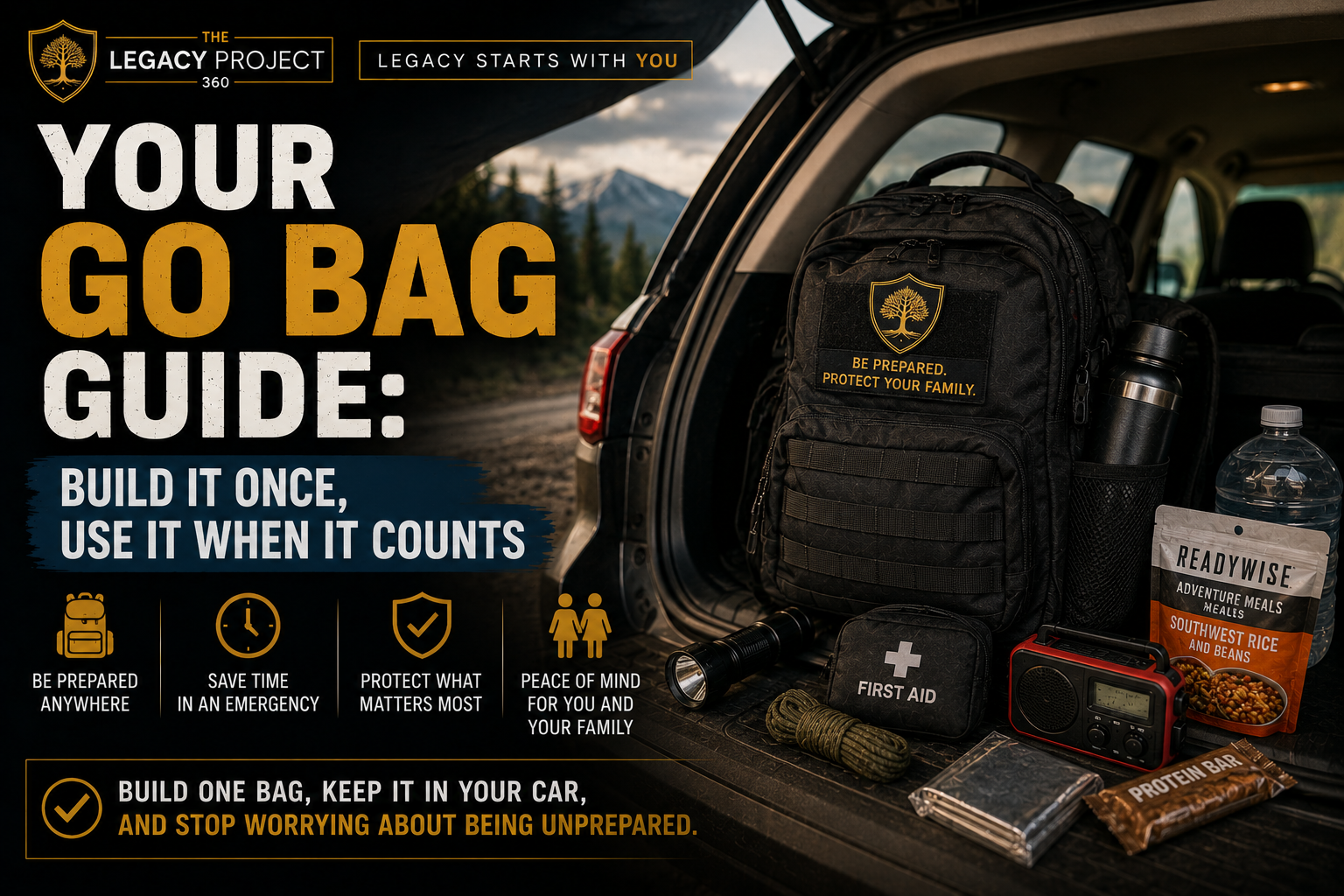
You do not plan for the bad days. You prepare for them. And preparation means having one practical bag in your vehicle that says, "Whatever happens next, we are not starting from zero."
A go bag is not a survival fantasy. It is not a statement about how worried you are. It is a small backpack that sits in your car, stays ready, and helps your family get through the first hours of something unexpected. That is all. Simple. Practical. Surprisingly reassuring once it is actually done.
What You'll Learn
Why one bag per vehicle works better than one bag per house
How size affects whether your bag actually stays in the car
Exactly what to pack in a go bag that fits in your trunk
Which medications cover the most situations
Why paper maps and cash still matter
How to maintain your bag so it is actually ready
"By failing to prepare, you are preparing to fail." — Benjamin Franklin
One Bag Per Car, Not One Bag Per House
Here is the mistake almost everyone makes. You spend a Saturday assembling the perfect go bag, feel great about accomplishing something, and then tuck it into a closet. Three months later, you are stuck two hours from home during unexpected weather with nothing but hope and anxiety.
The bag needs to live in the car. Not in the closet. Not in the garage. In the car.
If two people in your household drive separately, both vehicles need identical bags. Consistency matters under pressure. When your brain is already in crisis mode, you cannot afford to wonder which car has the medications. Both cars have them. Problem solved.
Think about it this way. You do not store your seatbelt at home just in case. Your seatbelt lives in the car because that is where emergencies happen.
A go bag that stays in your closet is just an expensive collection of good intentions. A bag that lives in your car is actually prepared.
Size Matters More Than You Think
Your go bag should be small enough that you forget it is there. That sounds wrong, but it is the most important detail about the bag itself.
A large tactical backpack that takes up half your trunk gets moved every time you load groceries. It gets left in the garage. It becomes furniture. A compact sling bag or small daypack tucked behind the seat stays put permanently. And a bag that stays in the car is the only bag that works.
Choose something that fits in a tight space. Something you barely notice once it settles in. That is your real go bag.
What Goes In Your Go Bag
Most guides at this point start listing things like you are building a remote wilderness kit. You are not. You are preparing to handle the first twelve to twenty-four hours of an unexpected disruption. Build for that, nothing more.
Here is what belongs in the bag, and why.
The Container: Tactical Sling Bag
Your bag matters. A sling bag is compact, sits flat, and does not demand trunk space. Look for something with organized compartments so you are not digging in the dark. You want durable, weatherproof, and modest enough that it lives permanently in your vehicle without creating clutter.
Light Source: Rechargeable Flashlight
The flashlight from your junk drawer died in 2009. Cheap flashlights fail at the moment you need them. A quality rechargeable LED flashlight works when it matters. Charge it at home every few months. Toss it in the bag. It will be ready.
Warmth: Emergency Thermal Blanket
These are absurdly small. An emergency thermal blanket folds down to the size of a deck of cards but reflects ninety percent of your body heat back toward you when you are cold, wet, or in shock. If you have ever been stuck waiting in unexpected weather, you understand why this belongs here. Get one per person in your household.
Signaling: Whistle
A whistle is one of those items that gets skipped because it seems unnecessary until it is the only thing that works. If you are injured and cannot move far, your voice will tire. A whistle carries farther and uses almost no energy. It is tiny. It costs almost nothing. Put it in without overthinking it.
Do not skip medications for any family member with a chronic condition. Talk to your doctor about maintaining a small emergency supply. Rotate it regularly so nothing expires.
Fire: Waterproof Matches
You might never need fire. You might. Either way, waterproof matches take up almost no space and serve multiple purposes. Warmth, light, signaling, cooking. If you have young children, keep them in a secure pocket. They are not toys, but they are worth having.
Power: Charging Cables and Blocks
Your phone is your lifeline. A quality dual-port USB cable handles multiple device types in one cord. A wall charging block for your hotel room or shelter. A car charger that gets constant use. And a portable battery bank with enough capacity to charge your phone at least twice. Buy all three. Charge the portable bank every month.
Tools: Multi-Tool
A quality multi-tool is one of the most versatile items you can carry. Knife, screwdrivers, scissors, saw, pliers in one compact package. From cutting a seatbelt in an accident to opening packages at a shelter, it earns its space. Buy a good one. Cheap multi-tools fail when it counts.
Water: Purification and Storage
Clean water is non-negotiable. Water purification tablets turn almost any water source into something safe to drink. They are lightweight, have a long shelf life, and take up almost no room. Pair them with a collapsible cup and you have a complete hydration solution.
Protection: Rain Poncho and Work Gloves
Weather does not care about your plans. A disposable rain poncho weighs nothing, costs nothing, and makes a miserable situation manageable. Pack one per person. A pair of durable leather work gloves protects your hands when you need to move debris or handle rough materials. Both fold flat.
Health: First Aid and Medications
You do not need a trauma kit. You need bandages, antiseptic wipes, gauze, and something for pain. A compact first aid kit handles minor injuries without turning your bag into a medical supply closet.
Then add four over-the-counter medications that together cover an enormous range of situations. Tylenol for pain and fever. Aspirin for pain and heart emergencies. Ibuprofen for inflammation. Benadryl for allergic reactions. Those four items address most minor ailments during an unexpected disruption.
Writing: Waterproof Notebook
Your phone battery will die. When it does, you will want a place to write down directions, phone numbers, and instructions. A waterproof notebook solves that completely. Keep a pen attached to it.
Navigation: Paper Maps
GPS fails. Cell service drops. Batteries die. When all three happen simultaneously, a paper map is your only navigation tool that still works. Include a folding city map and a state map. Highlight your home, workplace, nearest hospital, and key routes out of your area before you fold them up. That small step saves valuable time.
Money: Cash in Small Bills
Card readers go down. ATMs run out. In a real disruption, digital payment fails first. Tuck one hundred dollars in small bills into an interior pocket. Twenties, tens, fives, ones. You will almost certainly never use it. But if you do, it will feel like you planned brilliantly.
Because you did.
This week, gather the bag itself and these five essentials: a flashlight, a charging cable, a multi-tool, a whistle, and a first aid kit. That is your foundation. Add the rest as you have time.
Information Layer: Critical Details
Your go bag handles the moment. Information handles everything after.
Include a small, laminated card with essential information: a basic medical summary for each family member, emergency contact numbers written by hand, your family meeting plan, insurance contact numbers, and allergy or medication information. Your full Legacy Binder is too large to carry, but this condensed version covers decisions that need to happen quickly.
Do not include Social Security numbers, full account numbers, or login credentials. Assume anything in a vehicle could be lost. Build your information card to help your family without creating a security risk.
Maintenance: The Audit
Building the bag is the first step. Keeping it ready is the habit that matters.
Set a reminder every three to six months to open the bag, check expiration dates on food and medications, verify that batteries and charging banks are charged, and replace anything used or expired. A go bag ignored for two years is not a go bag. It is just a backpack with old granola bars and good intentions.
Build once. Check twice a year. Hope you never need it. But if you do, you will be ready.
The Whole Picture
Most people never face a true emergency. But most people also know at least one family who did and wishes they had been more prepared. A go bag does not take long to build. It does not cost much to maintain. It does not require you to become someone who talks about survival gear at dinner parties.
It requires about an hour of your time and the decision to stop putting it off. Your family does not need a perfect plan. They need a real one. This is it.
Where to Go From Here
A go bag buys you time in the first hours of an emergency. Real preparedness covers everything that comes after too.
Your go bag and your Legacy Binder work together. The bag handles immediate needs. The binder handles everything else. If you want to see how the Legacy Binder Family Preparedness System helps you organize, protect, and pass on everything that matters, visit thelegacybinder.com.
Build your go bag this month. One bag. One car. One hour of time. Everything else flows from there.