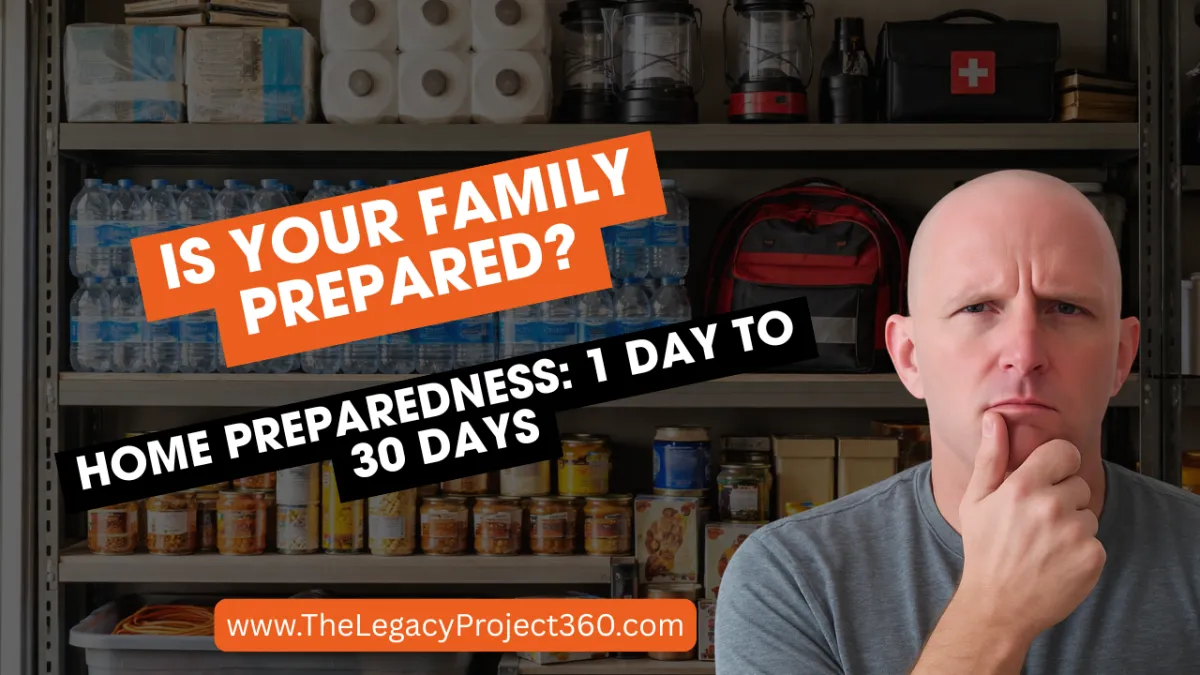
Home Preparedness 101: What Your Family Needs for 1 to 30 Days
If the years 2020 through 2022 taught Americans anything, it is that a rumor of a toilet paper shortage is apparently the trigger for a complete societal breakdown. People were fighting in Walmart parking lots over 24-packs of Charmin. Grown adults were hoarding 200 rolls in their basement like it was currency. One day we were normal people, and the next we were competing on a reality show called "Who Gets the Last Two-Ply."
According to data from NCSolutions, toilet paper sales surged 734% on March 12, 2020, compared to the same day the prior year, making it the top-selling grocery item in the world that day. Not medicine. Not food. Toilet paper.
This post covers basic home preparedness from one day through 30 days, including water, food, power, and supplies. You will walk away with a practical, low-stress plan your family can start building this week.
WHAT YOU WILL LEARN
What COVID actually revealed about American preparedness
How to prepare for 1 to 3 days without power, water, or food
How to build a 1 to 2 week supply on a normal budget
How to reach a full 30-day supply at home
The best emergency food suppliers you can order from today
Resources for going beyond 30 days if you want to keep growing
WHAT DID COVID REALLY REVEAL ABOUT AMERICAN PREPAREDNESS?
The toilet paper thing was funny, until it wasn't. Then came the flour shortage. Then hand sanitizer. Then yeast, because apparently everyone decided 2020 was the year to become a sourdough baker. Pasta, rice, canned goods, bottled water, and freezer meals disappeared from store shelves within days.
Toilet paper became a coveted item in late March 2020 when many cities and states issued shelter-in-place orders, prompting people to purchase large quantities of household goods. The core problem was not a supply chain failure. It was that most families had zero buffer. They were living week to week on what they bought last Sunday, which meant the moment stores slowed down, their pantries emptied out.
And according to FEMA, this problem did not go away after the pandemic. As of 2023, only 51% of Americans believe they are prepared for a disaster, and only 37% have actually made an emergency plan. That means roughly half the country is still one bad week away from the toilet paper wars.
Here is the good news: basic preparedness is not complicated. It does not require a bunker, a generator that costs $10,000, or a YouTube channel dedicated to the end of the world. It requires one intentional decision followed by steady, consistent action.
HOW DO YOU PREPARE FOR 1 TO 3 DAYS WITHOUT POWER OR WATER?
This is the foundation. Think of it as your no-excuses starting point.
What you need:
Water: According to Ready.gov and FEMA, you should store at least one gallon of water per person per day for several days, for both drinking and sanitation. For a family of four, that means a minimum of 12 gallons for three days. Aim for two gallons per person per day if you have infants, elderly family members, or pets.
Add to this supply a few hundred water purification tabs and you have a low-cost, lightweight backup that works anywhere. A single tablet treats one liter of water and costs less than a few cents. Brands like Potable Aqua and Aquatabs are widely available at outdoor retailers and on Amazon. For around $10 to $15, you can treat hundreds of liters of water from a tap, a stream, or a rain barrel. When your stored supply runs low, purification tablets turn almost any water source into something safe to drink and cook with.
Food: Stock at least three days of non-perishable food your family will actually eat. Canned soups, beans, tuna, peanut butter, crackers, dried fruit, and oats are all solid choices. Do not forget a manual can opener.
Power and light: Keep at least two flashlights with fresh batteries, a hand-crank or battery-powered weather radio, and a portable phone charger. A few good candles and matches in a waterproof bag will serve you well.
Basic supplies:
First aid kit with a manual
Prescription medications for at least a two-week overlap
Hand sanitizer and moist towelettes
Extra cash in small bills (ATMs go down when the grid goes down)
Copies of your key documents (ID, insurance, prescriptions)
"Your family does not need to be experts in survival. They need a shelf in the garage and the decision to fill it."
The easiest way to start: The next time you go to Costco or Sam's Club, buy one extra case of water, one extra case of toilet paper, and one extra case of paper towels. Put them on a shelf in your garage or a corner of your attic. That is it. You just started.
"Preparedness at home and preparedness on the go work together. If you have not built your family's go bag yet, read our full guide at www.thelegacyproject360.com/gobag."
HOW DO YOU BUILD A 1 TO 2 WEEK SUPPLY AT HOME?
Once you have three days covered, extending to two weeks is less about buying new things and more about buying more of what you already buy.
Water: For two weeks, a family of four needs a minimum of 112 gallons of water at one gallon per person per day. This sounds like a lot until you realize a case of water holds roughly four gallons. Buying two extra cases per Costco trip gets you there in a few weeks. You should also own at least one quality water purification method for backup. A LifeStraw family filter or water purification tablets are inexpensive and effective. If you have a gas grill or extra propane, you have the ability to boil water if your tap becomes unreliable.
Food: Build your two-week food supply around what your family eats normally. Rotate it. Use the oldest items first and replace them. Focus on:
Canned proteins (tuna, chicken, beans, lentils)
Canned or dried vegetables and fruit
Rice, oats, pasta, and flour
Cooking oil, salt, sugar, and honey
Peanut butter and nut butters
Coffee, tea, and comfort foods (yes, this matters for morale)
Power: A battery-powered or solar-charged camp lantern will carry you through most short-term outages. Two small propane camping stoves with four to six extra canisters let you cook without electricity or natural gas. These are worth owning.
Cooking in a disruption: If your gas is out, a propane camp stove handles everything you need. Keep a cast iron skillet, a medium pot, and a manual can opener with your supplies. Do not assume you will have access to a microwave.
HOW DO YOU BUILD A FULL 30-DAY SUPPLY AT HOME?
A 30-day supply is where preparedness starts to feel real. It is also where most people get overwhelmed and do nothing. Do not let that happen. Build this over 60 to 90 days, not all at once.
Water for 30 days: A family of four needs a minimum of 480 gallons of water for 30 days. That is not realistic to store in cases of bottles. At this level, you need one or two 55-gallon BPA-free water storage barrels, which are available at most preparedness stores or on Amazon for around $30 to $50 each. Fill them, treat them with a water preserver like Aquamira, and rotate them annually. Pair this with a gravity-fed water filter such as an Alexapure or Berkey-style filter so you have a treatment option for tap or natural water sources.
Food for 30 days: At this level, you combine your rotated pantry stock with purpose-built emergency food storage. A 30-day household supply for a family of four means roughly 4 individual 30-day kits, or two family kits depending on the supplier.
Here are three emergency food suppliers with proven products and strong reputations:
Mountain House Website: https://mountainhouse.com Mountain House offers freeze-dried meals with a 30-year shelf life. Their 30-day kit for one person includes 90 pouches covering breakfast, lunch, and dinner. Their 30-day emergency food kit provides approximately 1,732 calories per day per person and requires only water to prepare. No cooking equipment needed. The taste holds up well compared to competitors.
My Patriot Supply Website: https://www.mypatriotsupply.com My Patriot Supply offers a four-week kit that provides approximately 2,000 calories per day, includes 16 food varieties, and stores for up to 25 years in resealable, heavy-duty four-layer pouches. They are an A+ rated BBB business and ship most orders the same day.
4Patriots Website: https://4patriots.com 4Patriots offers a 4-week kit with freeze-dried meals and a 25-year shelf life. According to their site, the kit gives one person enough meals for 30 days, or two people for 15 days, and is designed for easy preparation in an emergency.
Additional 30-day supply checklist:
Prescription medications: Talk to your doctor about getting a 90-day supply
Hygiene: Soap, shampoo, toothpaste, feminine products, baby supplies
Sanitation: Garbage bags, toilet paper (yes, stock it intentionally), hand sanitizer, bleach
First aid: Expanded kit with bandages, antiseptic, pain relievers, cold medicine, and a thermometer
Communication: Hand-crank or battery weather radio, backup phone chargers, printed local maps
Tools: Multi-tool, duct tape, work gloves, a fire extinguisher, and a whistle
Fuel: Extra propane tanks for cooking, a reserve of gasoline in an approved container if you have a generator
Entertainment and morale: Books, board games, playing cards, and activities for your kids
WHERE DO YOU GO AFTER 30 DAYS?
Once your 30-day supply is in place, you are already ahead of most of your neighbors and most of the country. If you want to go further and work toward full self-sufficiency, here are three reliable resources:
The Provident Prepper (theprovidentprepper.org) is one of the most thorough and practical preparedness websites available. It covers water, food storage, power, and long-term self-reliance at a level that is detailed without being extreme.
City Prepping on YouTube (youtube.com/@CityPrepping) is a well-researched channel with content on everything from 72-hour kits to long-term power solutions. The production quality is high and the information is presented without fear-mongering.
The LDS Preparedness Manual is a free PDF that has been used by preparedness-minded families for decades. It covers food storage, water, fuel, medical supplies, and more in a thorough, step-by-step format. Search "LDS Preparedness Manual PDF" and you will find it through multiple free sources.
FREQUENTLY ASKED QUESTIONS
Where do I start if I have never done any emergency preparedness?
Start with three days. Buy one extra case of water and a few extra cans of food on your next grocery trip. Put them on a dedicated shelf. That shelf is your starting point. Add to it every time you shop. Do not wait until you feel ready to do it all at once.
How much water does my family actually need for an emergency?
According to Ready.gov and FEMA, store at least one gallon of water per person per day for several days, covering both drinking and sanitation needs. Plan for two gallons per person per day if you have small children, elderly family members, pets, or live in a warm climate.
Is it expensive to build a 30-day emergency food supply?
Not if you build it gradually. Adding two to four extra cans of food per shopping trip costs $5 to $10 per week. A purpose-built 30-day emergency food kit from suppliers like My Patriot Supply runs around $200 per person. Spread over two to three months, this is a manageable budget for most families.
What food should I store for an emergency?
Focus on food your family already eats. Canned proteins, rice, oats, pasta, dried beans, nut butters, and cooking oil form the foundation. For longer-term storage beyond 30 days, freeze-dried meal kits from Mountain House or My Patriot Supply provide variety, long shelf life, and easy preparation.
Do I need a generator for a 30-day preparedness plan?
Not necessarily. A propane camping stove with extra fuel canisters handles most cooking needs. Battery banks and solar chargers cover phones and small devices. A generator becomes more useful for medical equipment, refrigeration, and extended outages, but it is not a requirement for baseline 30-day preparedness.
CONCLUSION
COVID did not create the preparedness problem in America. It exposed it. Most families were one unexpected week away from empty shelves and real stress, and many still are. The solution is not extreme and it is not expensive. Buy a little extra every week. Stack it on a shelf. Work your way from three days to two weeks to 30 days. Your family will not notice the effort until the day they need it, and on that day, it will matter more than almost anything else you have ever done for them. Start this week.
CALL TO ACTION
If you want a simple, organized system for managing your family's preparedness, documents, and legacy planning in one place, visit thelegacybinder.com. The Legacy Binder gives your family a clear, step-by-step framework to protect what matters and pass it on.
TL;DR: COVID proved most American families have no buffer. Half the country is still unprepared according to FEMA. Fix that by starting small. Every Costco trip, buy one extra case of water, food, and supplies. Work from three days to two weeks to 30 days. Store one gallon of water per person per day, add purification tablets for backup, and stock non-perishable food your family will actually eat. For a full 30-day food supply, look at Mountain House (mountainhouse.com), My Patriot Supply (mypatriotsupply.com), or 4Patriots (4patriots.com). Build the habit now. Your family will not notice until the day it matters.


